The nine-card rows
Examine the large playing-card layout in Noe’s handbook and distinguish it from a modern single-card reading.
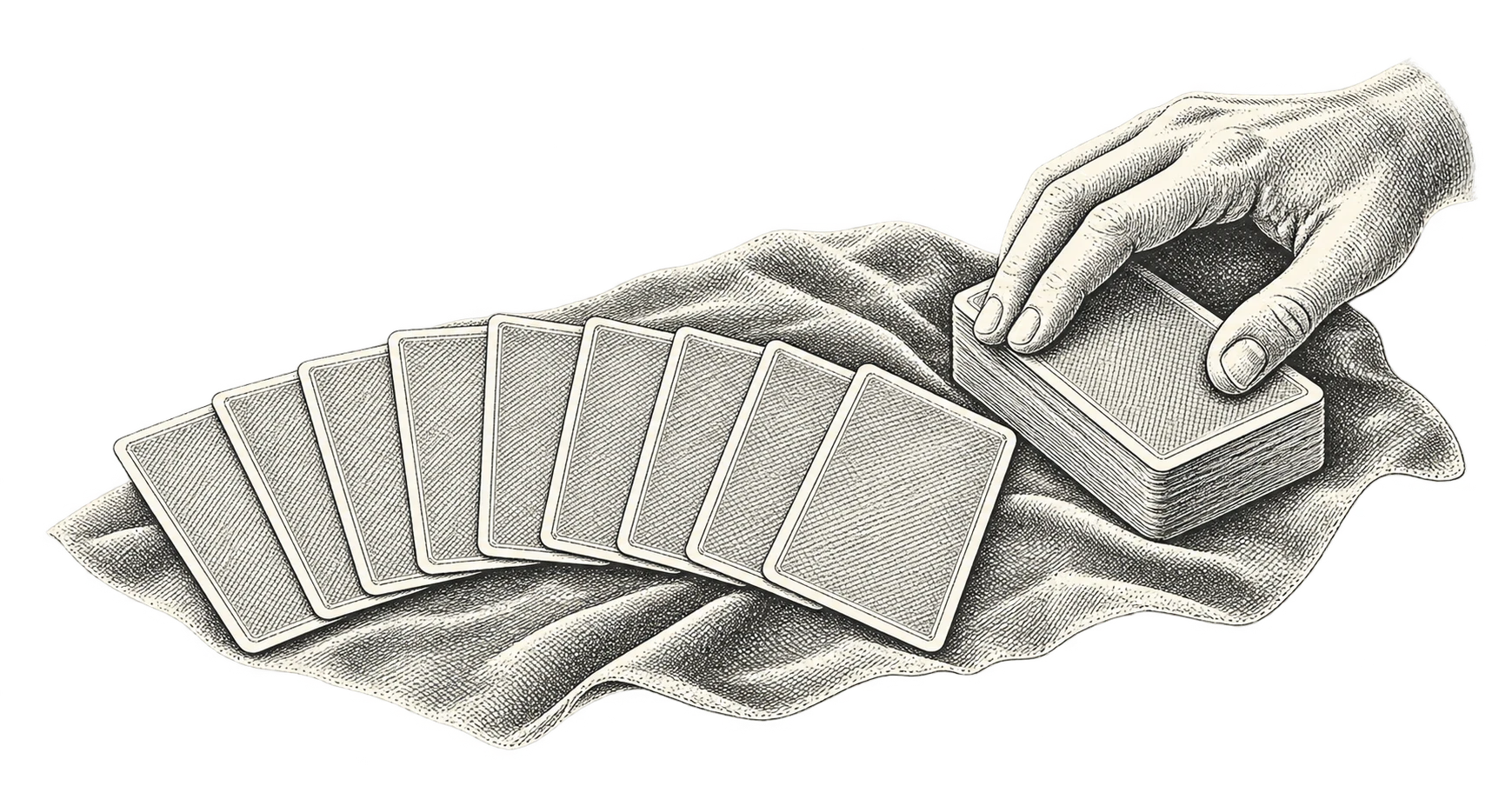
Nine cards across is a different undertaking from drawing a card for the day. Noe’s cartomancy section begins with repeated shuffling and cutting, then spreads the pack in rows and locates cards that stand for people in the reading.
It is worth looking at the whole arrangement before copying any individual meaning. A court card in this system has work to do within a layout. It is not automatically an instruction to find a real person who matches a short description.
A layout built around people
The printed account assigns kings and queens through a binary picture of the questioner and partner. It then gives importance to cards counted at a specified distance from those representatives. Those assumptions belong to the source; they need not decide which card a contemporary reader is allowed to use.
A full pack also does not divide into complete rows of nine. The description should be studied with that practical question in mind rather than illustrated as a neat rectangle with invented extra cards.
Keep the vocabulary attached
Noe lists suit and rank meanings after the layout instructions. Taking a favourable sentence from one entry and joining it to meanings from another deck book makes a new system. That may be a reader’s chosen practice, but it should not be attributed whole to this handbook.
This article introduces the printed layout rather than issuing a simplified spread under its name. For a complete contemporary practice with a much smaller scope, use the single-card oracle. Its flexibility is declared at the start, and it does not pretend to reproduce these nine-card rows.
Source and reading notes
The layout is treated as historical material. No invented final-row rule, significator rule, or substitute fifty-two-card key is presented as Noe’s method.
A. H. Noe, The Witches’ Dream Book; and Fortune Teller (1885). Chartology, p. 77 onward.