The domino oracle
Read one tile from a double-six set with an attributed historical answer table, including its two missing meanings.
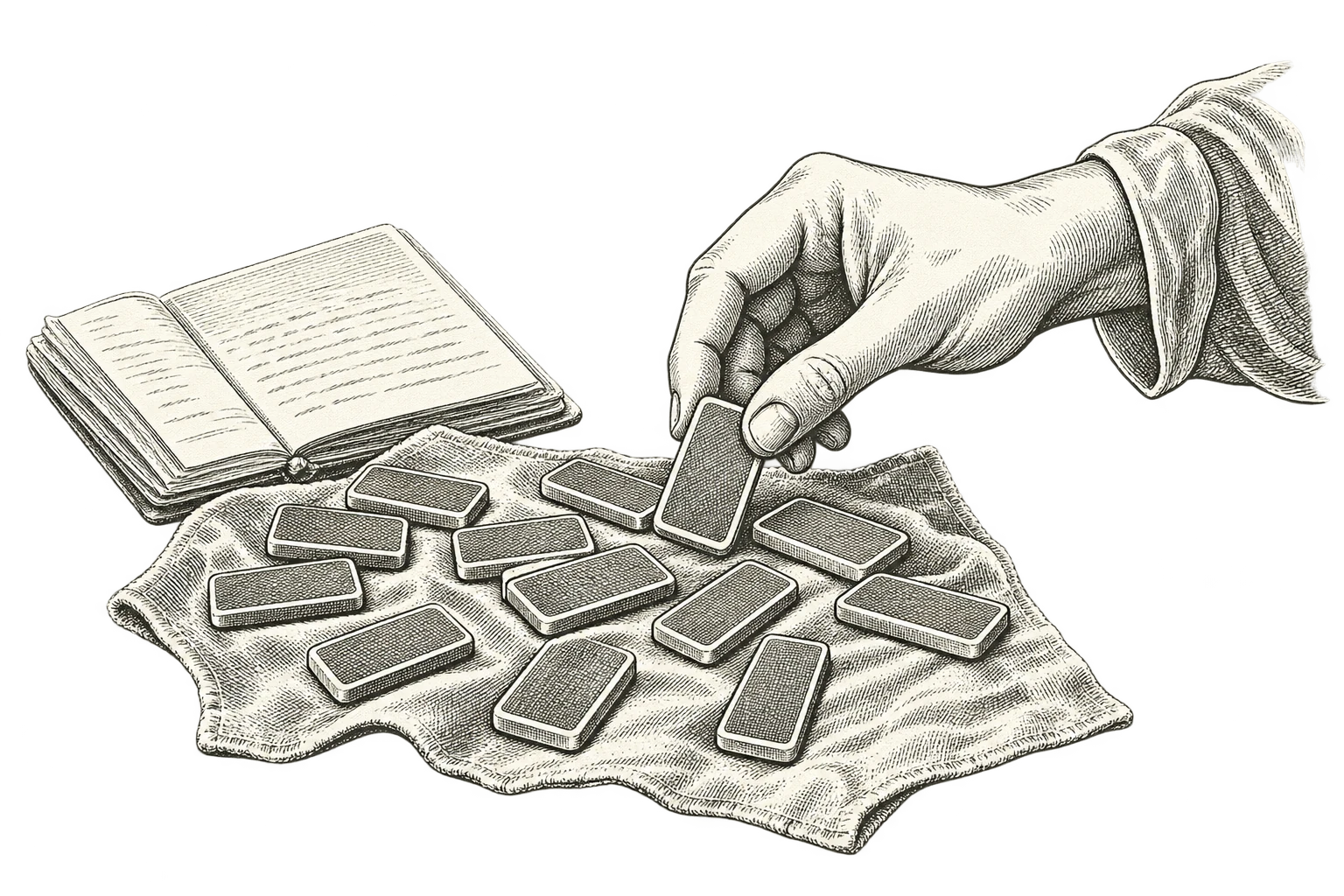
If there is an old box of dominoes in the house, open it and check the tiles before you begin. You want an ordinary double-six set: twenty-eight pieces, from double blank through double six. A missing tile changes what can be drawn.
This reading uses one tile. Turn the pieces face down, mix them across a cloth, and let your hand choose. There is a different feel to working with their weight and smooth backs after using cards for a while.
What to gather
- A complete double-six domino set
- A cloth or clear tabletop
- A notebook
Write your question first. Keep it to something you are willing to consider rather than a demand to know another person’s secrets. Then turn the tiles over and mix them until you have lost track of their positions.
Draw one tile and set it apart before turning it face up. Record both numbers, including any blank. In this method, 6–2 and 2–6 are the same tile.
The printed meanings
The following is a compressed paraphrase of the answer table in Noe’s 1885 handbook. Some meanings reflect the book’s social attitudes or predict distressing events. They belong to the historical table, not to reliable forecasts.
| Tile | Printed association, paraphrased |
|---|---|
| 6–6 | Money received |
| 6–5 | An outing |
| 6–4 | Litigation |
| 6–3 | Carriage travel |
| 6–2 | Clothing given |
| 6–1 | Kindness offered |
| 6–0 | Gossip |
| 5–5 | A favourable move |
| 5–4 | Profitable speculation |
| 5–3 | A superior’s visit |
| 5–2 | A waterside excursion |
| 5–1 | Romantic intrigue |
| 5–0 | A nonrelative’s funeral |
| 4–4 | Drinking away from home |
| 4–3 | Needless alarm |
| 4–2 | Theft or fraud |
| 4–1 | Creditors |
| 4–0 | An angry correspondent |
| 3–3 | An unwelcome sudden marriage |
| 3–2 | Gambling losses |
| 3–1 | Discovery |
| 3–0 | A birth outside marriage |
| 2–2 | A partner’s jealousy |
| 2–1 | Property pledged |
| 1–1 | Something advantageous found |
| 0–0 | Unanticipated trouble |
The table in this source has twenty-six entries. It omits 2–0 and 1–0. Leave those two results unassigned if you are following this table; do not quietly borrow answers from another system. This gap is a good reason to keep the source beside your reading.
Working with the result
Copy the association beneath your question. Notice your first response before trying to make the answer fit. Did the tile remind you of a particular concern, or did it seem unrelated?
Read a troubling association as a piece of historical symbolism you have encountered. A tile cannot establish that a death, betrayal, or financial loss is coming. You can stop the reading without drawing again to cancel it.
If you prefer to make a personal answer table, write the whole table before the next session and label it as your own. That becomes a different version of the working, which is worth recording clearly.
Source
A. H. Noe, The Witches’ Dream Book; and Fortune Teller, “Auguries by dominoes,” printed page 82. The preparation, question-setting, and commentary above are editorial additions.
Explore the practice
Explore divination rituals for more context and related workings. For help choosing materials and recording your experience, read witchcraft for beginners.