The three-dice circle
Cast three dice in a marked circle and consult a printed 1885 answer table, kept distinct from Okkult’s other dice method.
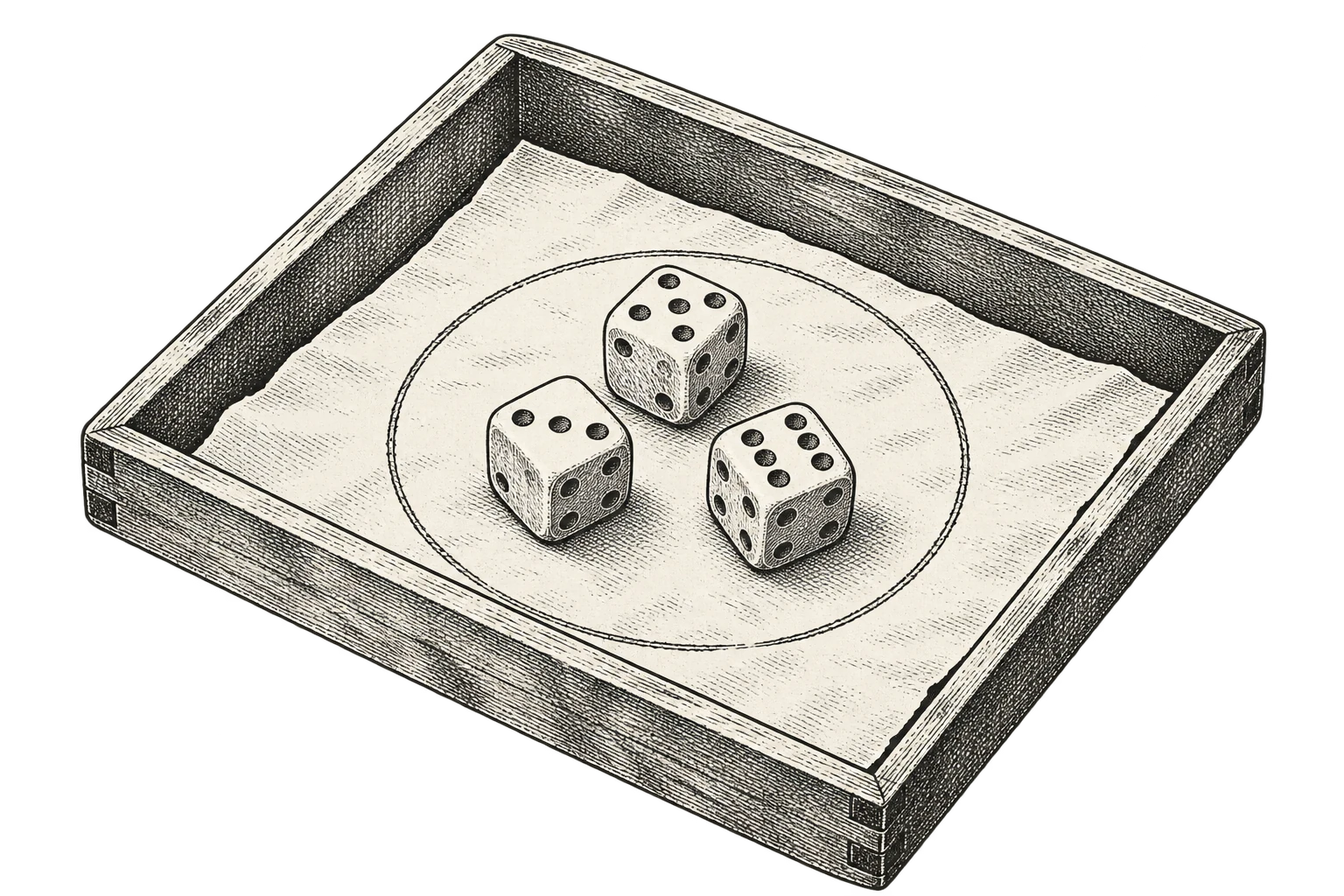
Use three ordinary six-sided dice and a tray you can mark without damage. This method adds their faces into one total. It is different from the archive’s three-dice oracle, which reads each die separately.
The table below paraphrases the totals in Noe’s handbook. Its forecasts belong to the printed system. You can study them without accepting that a throw determines what will happen.
Make one cast
- Draw a circle on a sheet of paper and place it in a tray. Write one question before touching the dice.
- Shake all three dice and cast them together. If all remain within the circle, add their upper faces.
- Read the total in the table. If a die leaves the circle or the tray, record that result separately rather than forcing a valid total.
- Write your first association, then gather the dice away. Keep the record even if the answer seems irrelevant.
| Total | Printed association, paraphrased |
|---|---|
| 3 | Welcome surprise |
| 4 | Unwelcome surprise |
| 5 | A stranger becomes a friend |
| 6 | Property lost |
| 7 | Unfair gossip |
| 8 | Deserved criticism |
| 9 | Marriage |
| 10 | A baptism |
| 11 | A death affecting the reader |
| 12 | Correspondence arriving |
| 13 | Sorrow |
| 14 | A hostile scheme |
| 15 | Good fortune |
| 16 | Enjoyable travel |
| 17 | Favourable waterside dealings |
| 18 | Substantial advantage |
Keep the throw in proportion
The source also gives meanings to dice leaving the circle, falling, or stacking, and promises a short fulfilment period. This version records irregular throws without those further forecasts. Decide that rule before casting.
An alarming total is a historical association, not news of a real death or loss. There is no need to keep throwing to remove it. For consequential questions, use information you can verify outside the tray.
Source and reading notes
The three-dice sum and circle are sourced. Preparation, recording, and the treatment of irregular casts are editorial choices; the table is paraphrased rather than replaced with another system.
A. H. Noe, The Witches’ Dream Book; and Fortune Teller (1885). “Prognostications by dice,” p. 81.
Explore the practice
Explore divination rituals for more context and related workings. For help choosing materials and recording your experience, read witchcraft for beginners.