Ezekiel’s wheels: divine vision, UFO or mystical chariot?
Ezekiel’s wheels in the Bible, modern UFO interpretations and Jewish chariot mysticism: read the full vision and the different questions asked of it.
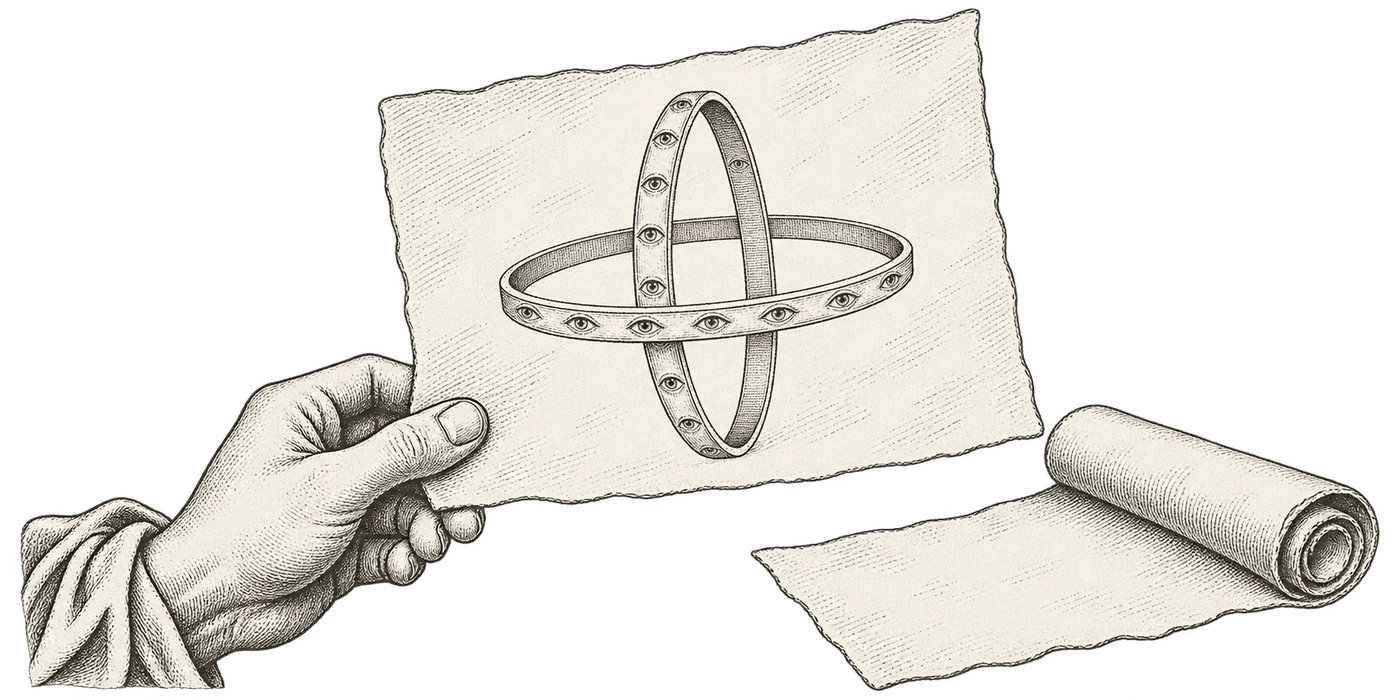
A wheel within a wheel is an image that asks to be drawn. Give it a rim, choose an angle, add the eyes. Before long, the pencil has made a machine out of a sentence. Another reader draws a heavenly being. A third leaves the page crowded with circles that refuse to become either.
Ezekiel’s opening vision has room for that difficulty. It is full of motion, fire and likenesses. But the wheels belong to a larger scene, and the scene has a stated purpose. To read it well, begin before the famous phrase and continue after it.
The vision around the wheels
Ezekiel 1 places the speaker among the exiles by the river Chebar. A storm, cloud and fire introduce four living creatures. Each has four faces and four wings. Wheels stand beside them, their rims covered with eyes; their movement follows that of the creatures. Above them is an expanse, and above that a throne with a humanlike appearance upon it. The chapter ends by identifying the scene with the glory of the Lord. In Ezekiel 10:20, the creatures are identified as cherubim.
Those details are the architecture of the account. A reading that keeps the wheels while removing the creatures, throne and concluding identification has selected a different object of study. It may be an interesting object, but it should be named as a selection.
The repeated language of likeness matters. Ezekiel reaches for familiar things to describe what the vision presents. A comparison with crystal is not a laboratory analysis of a substance. A humanlike appearance does not, by itself, identify an occupant as a pilot. The wording gives us something vivid to imagine while keeping the act of description visible.
Why a spacecraft comes to mind
A modern reader may recognise a coordinated vehicle in the scene: parts move together, brightness surrounds them, and something occupies an elevated position. A technological interpretation can turn those details into components, energy and a command position. That is an interpretive proposal. The text does not supply those modern labels.
Josef F. Blumrich’s The Spaceships of Ezekiel, published in English in 1974, makes the technological approach explicit in its title. The book belongs to the modern history of reading Ezekiel as a spacecraft account. Its existence establishes that history of interpretation; it does not make the interpretation an archaeological finding.
There are two questions to keep apart. Could someone design a vehicle inspired by this description? And did a vehicle produce the account? A successful drawing, model or engineering exercise would answer the first much more readily than the second.
The drawing must choose dimensions the passage does not provide. It must decide which comparisons are literal parts and which are descriptive flourishes. A convincing result may show the skill of the designer and the flexibility of the source together. It needs additional evidence before it can establish an ancient machine.
The mystical chariot
There is also a history of religious interpretation between Ezekiel and modern UFO literature. Michael Lieb’s Children of Ezekiel discusses the later designation merkabah, or throne-chariot, and traditions of approaching the divine throne. In those traditions, the vision becomes a setting for sacred knowledge and the encounter with God. Lieb also examines the later impulse to render divine power in technological terms.
These are different developments around a shared text. Jewish chariot mysticism deserves its own historical and religious setting. Folding it into a general category called “the occult” can hide the particular literature, theological concerns and communities involved.
Nor should modern uses of the word merkabah automatically be treated as descriptions of the same practice. A familiar name can pass through several bodies of writing. Establish which text and period a writer means before connecting their diagram to an older account.
The useful question is how a vision becomes available for further thought: contemplation of divine presence, an account of heavenly ascent, a mechanical reconstruction. We can trace those uses without assuming they disclose one hidden technical meaning.
Three readings, different questions
| Reading | What it asks of the passage | What requires further support |
|---|---|---|
| Biblical and historical | How does the vision work within Ezekiel’s account of God, exile and prophetic speech? | Claims about its setting and imagery need textual and historical evidence |
| UFO interpretation | Could the description be understood as an encounter with a technological vehicle? | A proposed physical origin needs evidence beyond visual resemblance |
| Mystical interpretation | How have later readers used the throne vision to understand sacred knowledge and encounter? | A particular practice or teaching needs an identifiable source and period |
This is a map of questions, not a vote in which all explanations receive equal support. A study of how a text has been used can succeed while leaving the origin of a reported vision unresolved. A physical explanation has a different burden.
What an illustration decides
The wheels are especially vulnerable to pictures that settle a question before the reader reaches the text. A diagram may make them look like a gyroscope. A devotional image may organise them into an angelic figure. A spacecraft illustration may add a hull that the artist needs to make the design coherent.
Look for the additions. Count the parts, notice what has been omitted, and ask where the measurements came from. The exercise applies to Okkult’s illustration too: it selects the wheel motif and offers a literary image. It is not a complete diagram of the vision or a recovered view of an event.
An image can help us see what an interpretation means. Its usefulness does not depend on becoming evidence for that interpretation.
Read to the end of the scene
For a close reading, place Ezekiel 1:15–21 beside 1:26–28, then turn to 10:15–22. Notice what happens when the isolated wheel passage returns to its neighbours. Keep the coordinated motion, but also keep the throne, the conclusion and the later identification of the creatures.
If you sketch the passage, mark any feature you supplied yourself. A chosen viewing angle, a hidden support or a metal casing belongs in that category. This is an original Okkult reading exercise, not a method prescribed by a mystical tradition.
The whole scene is stranger and more demanding than a wheel lifted out of it. Let that larger scene stay on the page while you consider what different readers have made of it.
Continue with Angels, demons and aliens: who is speaking? and Why occult books borrow from the Bible. For a later apparition case, read Fátima and the UFO interpretation.
Book sources and reading notes
- The Holy Bible, King James Version, first published in 1611, consulted in the Project Gutenberg transcription. Ezekiel 1:1–28 and 10:15–22. Digitised Bible. The discussion follows this English wording; no original-language translation or textual collation is claimed.
- Michael Lieb, Children of Ezekiel: Aliens, UFOs, the Crisis of Race, and the Advent of End Time (Duke University Press, 1998), Introduction, particularly pp. 1–17. Digital book preview. The introduction was consulted for the history of the throne-chariot interpretation and the relation between divine and technological imagery. Later chapters were not available in this preview.
- Josef F. Blumrich, The Spaceships of Ezekiel (Bantam Books, 1974). Bibliographic reference for the modern spacecraft interpretation. This article does not review or verify the book’s technical reconstruction.