Fátima: apparitions, strange lights and the UFO interpretation
The children’s apparition accounts, the crowd’s solar reports, and what changes when Fátima is read through a UFO interpretation.
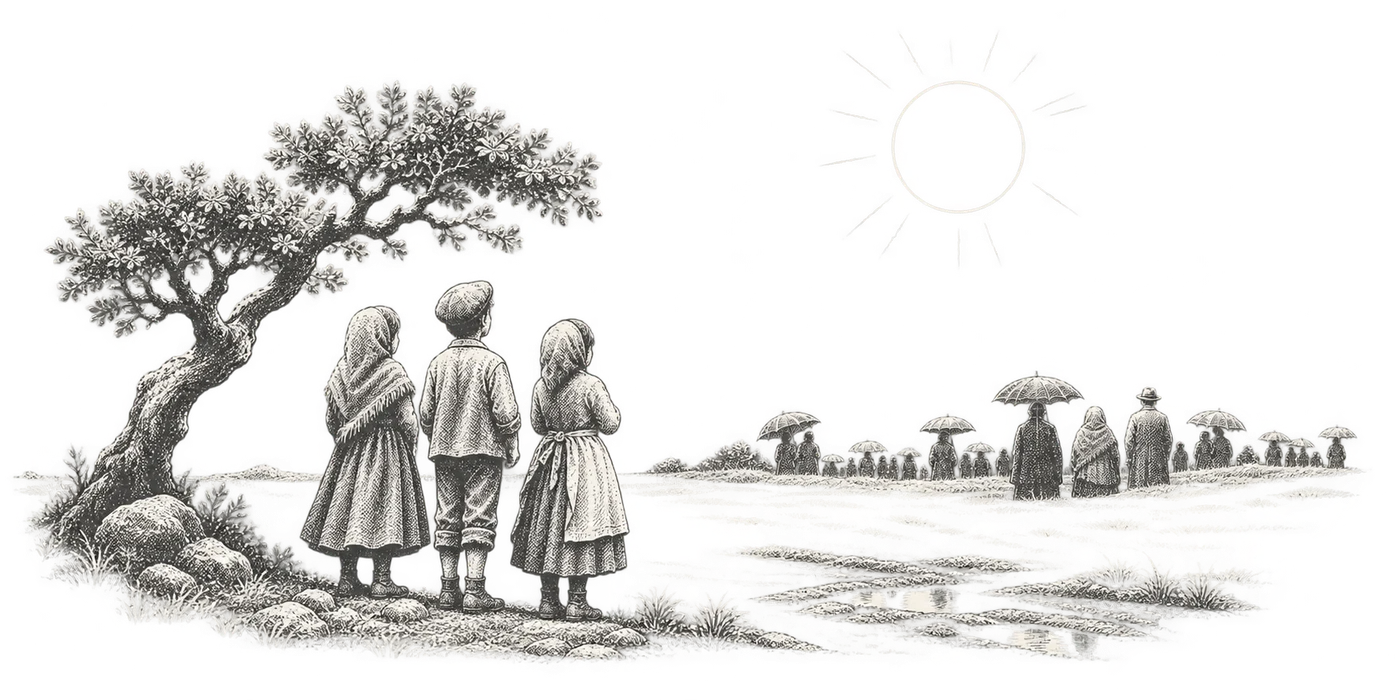
A wet field, a small oak, people looking upward. Fátima has become such a familiar image that it is easy to arrive with the explanation already chosen. A Catholic reader may recognise a Marian apparition. A UFO reader may look for an aerial encounter. Each needs to return to the accounts before deciding what the scene contains.
The interesting question begins with a distinction: what the children said appeared to them, and what members of the crowd described seeing in the sky. These are connected strands of the Fátima story. They require separate reading.
The children’s account
In 1917, Lúcia dos Santos and her cousins Francisco and Jacinta Marto reported encounters with a lady near Fátima in Portugal. Lúcia’s later Memoirs place them within Catholic devotion: the Rosary, prayer, repentance and a request for a chapel. Her account of October 13 identifies the visitor as Our Lady of the Rosary and describes further holy figures beside the sun. See the Fourth Memoir, section “The 13th of October, 1917,” in the digitised book.
That religious content belongs to the account. Replacing every holy name with “entity” would change the material being studied. Equally, repeating Lúcia’s identification does not independently establish who or what appeared. A reader can preserve her understanding while leaving the cause open.
The memoir form matters too. These are later recollections, written within a devotional setting. The edition’s own introduction discusses interpretation and difficulties with remembered details. A memoir gives us a witness’s account shaped into writing; its dialogue should not be treated as an audio recording.
The crowd and the sun
For the public event, turn to the collected documents. Avelino de Almeida’s report for O Século, published on October 15, 1917, describes rain, a large gathering and people turning toward the sun. He compares its appearance to dull silver and reports the crowd’s reaction to apparent movement. The text survives as document 13 in Documentação Crítica de Fátima: Seleção de documentos (1917–1930), pp. 72–77. Book edition.
Notice how much depends on the verbs. Someone describes a pale disc. Someone interprets movement. Someone hears a neighbour cry out. Those observations can belong to the same occasion without being interchangeable evidence. A newspaper account of a crowd also contains a reporter’s selection of what to describe.
The size of a gathering cannot tell us that every person saw the same thing. Nor does a report about the sun establish that the observer saw the lady described by the children. Keeping those questions apart makes the case more interesting, because it restores the different people in the field.
Why a UFO reading attracts attention
A disc, unusual light and apparent movement are details a modern reader may associate with UFO reports. The comparison offers a different way into a familiar religious story. It asks whether the vocabulary of a witness’s world helped determine the name given to something extraordinary.
Jacques Vallée’s Passport to Magonia, first published in 1969, provides a broader setting for this approach. It compares modern encounter narratives with older accounts of visitors from other realms. That comparative argument is worth examining on its own terms. It does not make a flying craft appear in every earlier description of light.
At Fátima, the word “disc” needs particular care. The sun has a visible disc. A witness’s comparison with silver describes an appearance; it does not supply an object’s material, dimensions or propulsion. Before drawing a spacecraft around that word, ask what the full passage actually says.
“Unidentified” can mark a limit in our knowledge. “Extraterrestrial” proposes an origin. The second requires evidence beyond the first.
Reading competing explanations
Religious and UFO interpretations ask different questions of the material. A religious reading considers the identity of the apparition, its message and its place within faith. A spacecraft interpretation needs grounds for inferring a physical vehicle. An account based on perception or atmospheric conditions needs to show how its proposed mechanism fits the particular reports.
None becomes adequate merely by naming a possibility. Ask each explanation which detail it addresses, what evidence it uses and what it leaves unresolved. A proposal that explains an apparent change in the sun’s colour may say little about the children’s reported conversations. An account of those conversations may leave the public solar reports unexplained.
There is room for uncertainty at that level. We do not have to compress a sequence of encounters, a public gathering and decades of interpretation into one answer.
A page for the case
If Fátima belongs in your grimoire’s reading section, give it a source page. Choose one passage from the collected documents and record its date, author and publication. Keep a separate line for the date of the event being described. Copy only the few words needed for the point you are examining.
Then write your interpretation underneath. Mark which details support it and which details would make you reconsider. Leave another reader’s conclusion in their own name.
This is a contemporary study prompt, not a reconstructed devotional practice. It gives the mystery somewhere precise to remain: in an account you can return to, with its questions still attached.
Continue with Angels or aliens? How culture shapes extraordinary encounters and Why do UFO researchers study religious visions?.
Book sources and reading notes
- Lúcia de Jesus, Fatima in Lucia’s Own Words: Sister Lucia’s Memoirs, edited by Louis Kondor, translated by the Dominican Nuns of the Perpetual Rosary, 16th edition (Secretariado dos Pastorinhos, 2007). Introduction, especially pp. 11–13; Fourth Memoir, “The 13th of October, 1917,” pp. 182–183. Digitised edition. Read as retrospective testimony within its devotional and editorial setting.
- Santuário de Fátima, Documentação Crítica de Fátima: Seleção de documentos (1917–1930) (2013), document 13, Avelino de Almeida’s October 15, 1917 report, pp. 72–77. Digitised edition. The Portuguese report supports the discussion of the public gathering and solar descriptions; the paraphrases here are Okkult’s.
- Jacques Vallée, Passport to Magonia: From Folklore to Flying Saucers (Henry Regnery, 1969). Included for its comparative framework, not as independent verification of Fátima. The author’s presentation of the book was consulted; no page-specific claim about its Fátima discussion is made.