Angels or aliens? How culture shapes extraordinary encounters
A presence, a light, a messenger: how witnesses and later readers give extraordinary experiences a name, and what those names leave unsettled.
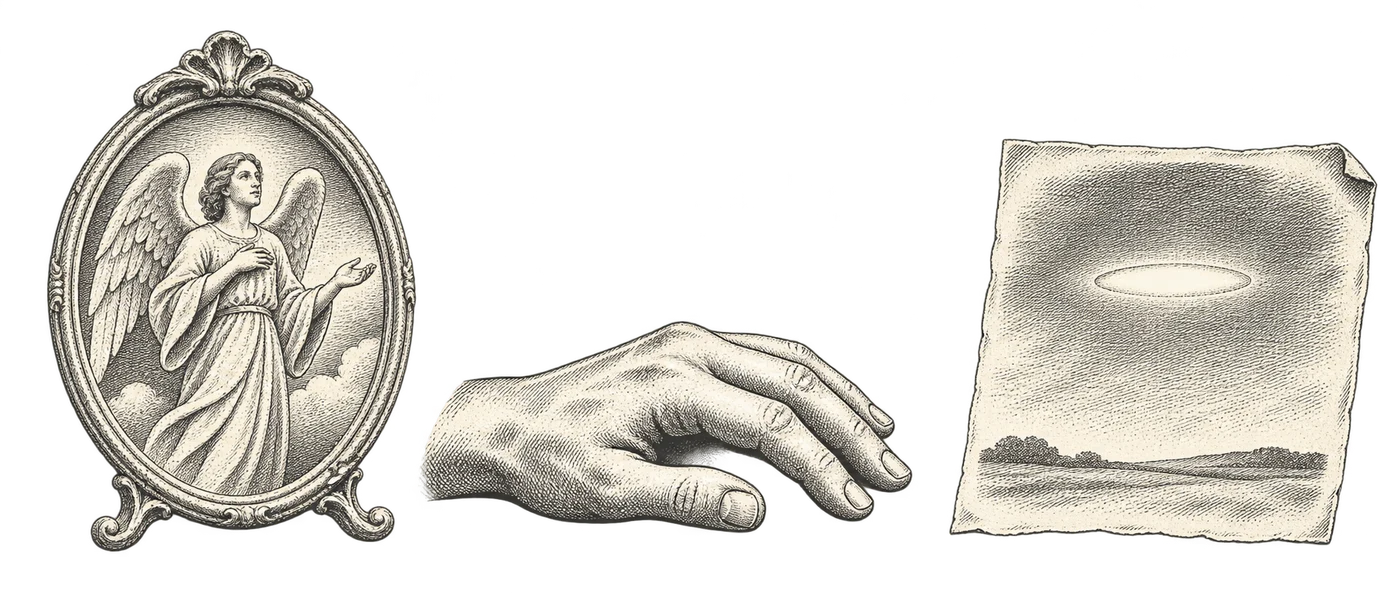
A light is a description. An angel is an identification. A visitor from another planet is an identification too. When an encounter passes into a story, those different kinds of statement can settle so closely together that we stop noticing the join.
For anyone who keeps a grimoire, the distinction is familiar. A shape appears in the scrying bowl; a name comes to mind. The name may matter deeply to the person reading. A careful notebook still gives the shape and the name their own space.
Religious apparitions and UFO encounters invite the same care, on a much larger historical canvas. We can examine how an experience acquires meaning without pretending that we have recovered an untouched moment before interpretation began.
The feeling of a presence
In The Varieties of Religious Experience, William James discusses reports of an intensely felt presence, sometimes without an ordinary visual encounter. In Lecture III, he distinguishes the force of that sense of reality from the way a person understands it. His examples help us ask why an experience can feel certain while its explanation remains disputed. Read Lecture III in the book.
That is a useful distinction when reading a witness. “I knew someone was there” tells us something different from “I saw a person standing by the door.” Neither sentence should quietly become the other in a retelling.
Ask what was reported: a visible figure, a voice, an intuition, a dream, a waking presence. Several may occur together in an account. An apparition, a mystical experience and an unusual aerial sighting are useful terms precisely because they need not describe the same kind of event.
The name that becomes available
Ann Taves’s Religious Experience Reconsidered shifts attention toward how people attribute meaning to experiences. Its framework offers a practical question: through what process does an event come to be understood as religious, spiritual or otherwise special?
Apply that question gently. Ask which words the witness used, when they used them, and who helped explain what had happened. A later identification might clarify an earlier impression. It might also add claims the earlier account never contained. The dates of those statements help us judge the difference.
We should be cautious about inventing an easy historical sequence in which people once saw angels and now see aliens. Contemporary people can use religious language, technical language, both, or neither. A writer who changes every old messenger into a space traveller has brought a modern interpretive habit to the archive.
The reverse shortcut is just as limiting. Calling every unsettling encounter demonic gives a conclusion before the individual account has been examined. Both approaches can make unfamiliar material feel manageable. Neither removes the need to read it.
An imagined encounter
Consider this invented example, offered only to show the difference between description and explanation. A person wakes at night, notices a bright oval near the window and feels watched. They cannot judge its distance. By morning they describe a visitor. After speaking with a friend, they begin calling it an angel.
There are already several questions. Was the oval seen while fully awake? Was “visitor” the first word used, or a later interpretation? Did the person see a figure? What did the friend hear before suggesting a name?
If a UFO writer retells this as a being arriving in an oval craft, the retelling has added a body, a vehicle and a journey. If a devotional writer supplies wings and a message, those details are additions too. An illustration could introduce the same changes without a single sentence doing so.
This is why the earliest available description is valuable, even when it is incomplete. Its uncertainty may be one of the most useful things it preserves.
Resemblance and difference
Vallée’s Passport to Magonia draws attention to recurring visitor narratives across folklore and UFO literature. The invitation to compare is fruitful. A messenger who arrives from elsewhere, an unusual light and a life changed afterward give a reader possible points of comparison.
Each is also a fairly broad feature. To assess a proposed connection, ask how specific it is. Do the accounts describe the same action? Are the records independent? Does one author borrow from another? What details resist the comparison?
The setting can be as revealing as the resemblance. A command to pray has a devotional meaning that “information download” may fail to carry. A claim about a machine invites questions that a dream visitation may never raise. Preserve those differences long enough to see what they do.
Keeping your own words visible
In a study notebook, set down a short passage and its source. Follow it with the witness’s identification, then your own reading. If the witness has already interpreted the event, say so. A sentence can contain both an observation and an explanation.
For a personal practice, the same habit can leave room for intuition without making every association a fact about the outside world. You may write that an image reminded you of a holy figure, an ancestor or a visitor. You can also record that the identification came later, and that you remain unsure.
An encounter does not lose its power because its name stays provisional. Sometimes the most faithful note is the one that lets the original uncertainty survive.
For a historical case, read Fátima: apparitions, strange lights and the UFO interpretation. For the research questions behind these comparisons, continue with Why do UFO researchers study religious visions?.
Book sources and reading notes
- William James, The Varieties of Religious Experience: A Study in Human Nature (Longmans, Green, 1902), Lecture III, “The Reality of the Unseen.” Digitised text. Used for the distinction between a felt presence and its interpretation, not to classify a particular modern witness.
- Ann Taves, Religious Experience Reconsidered: A Building-Block Approach to the Study of Religion and Other Special Things (Princeton University Press, 2009). Introduction, pp. 3–15, and chapter 4, pp. 120–160. The digital book record and chapter extracts were consulted for the attributional framework; this article does not claim access to the full chapters.
- Jacques Vallée, Passport to Magonia: From Folklore to Flying Saucers (Henry Regnery, 1969). The author’s presentation of the book supplies its stated comparative scope. The questions and imagined encounter above are original Okkult teaching material.