The fountain mirror
Follow Forsyth’s account of a mirror at a spring, keeping its medical interpretation within the historical report.
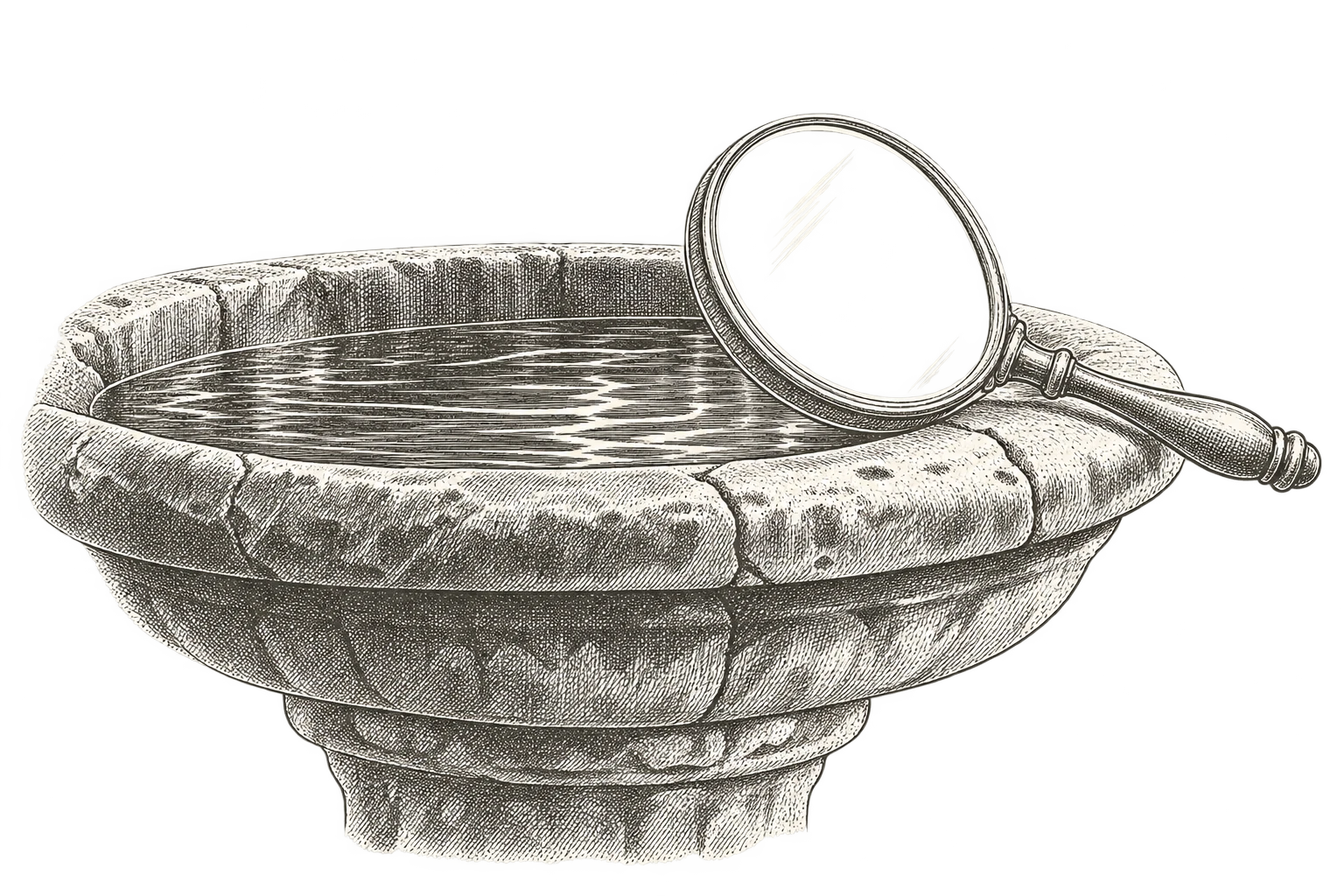
A mirror lowered towards water gives a divination story two surfaces to work with. In Forsyth’s account, attributed to Pausanias, the reflected appearance of an ill person is read as an omen of death or recovery near a temple of Ceres.
The account belongs to a particular setting. It is not evidence that every dark bowl or mirror-gazing exercise descends from that consultation.
Reflection and circumstance
The light, the angle, the moving water, and the person looking all have a place in what a mirror shows. A face can appear strange without becoming a prognosis. The historical account’s confidence does not remove those ordinary conditions.
Forsyth places this description under catoptromancy, divination by mirrors. A category name helps locate it in his compilation, but it does not supply the missing details of each consultation or authenticate every later practice filed under that name.
Read it beside a modern bowl
The archive’s still-water mirror is a contemporary exercise. It uses a bowl, a short pause, and a notebook; it does not ask a reflection to decide a medical outcome. This historical comparison supplies context, not a pedigree for that exact sequence.
When you make a source note, write both facts down: the older account uses a reflected image, and the present exercise differs in setting, materials, question, and interpretation. The resemblance is useful without having to become a claim of uninterrupted transmission.
This article provides no diagnostic method. A troubling reflection is not evidence that a person’s health will worsen.
Source and reading notes
The account is identified as Forsyth’s report through Pausanias. Its verdict about illness remains a historical claim, not a reading instruction.
J. S. Forsyth, Demonologia (1827). Catoptromancy, p. 147.