Water scrying.
Begin with a still bowl and a question you can examine. Water scrying gives you a surface for noticing reflections and associations. This guide develops Okkult’s contemporary bowl exercise into a complete first session and a record you can return to.
What is water scrying?
In this guide, scrying means attending to a surface and exploring the images, words or associations it suggests. The surface can remain ordinary: a reflection of the window, the edge of the bowl or the movement that settles after you put it down. A vivid vision is not a requirement.
The practice here uses observation followed by interpretation. Those are separate stages. A reflection can help you ask a different question without revealing a hidden fact or determining what another person intends.
Set out the bowl
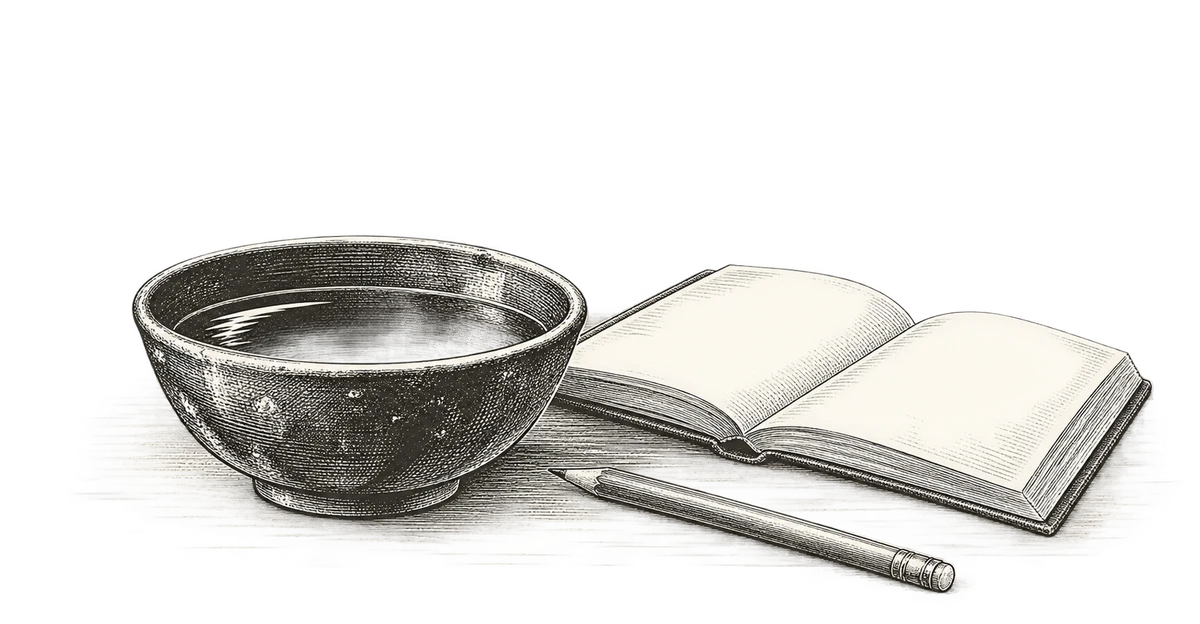
Gather a stable bowl, a little plain water, a notebook and a pencil. A dark interior can make reflections easier to notice, but it is optional. Use a bowl you already own rather than buying a special mirror. Keep electronics and loose papers away from spills.
Sit comfortably in ordinary room light. Choose an angle where you can look at the water without leaning over it or staring into a bright reflected light. Put the notebook where you can reach it. Leave enough light to write and to move around normally.
| Item | Its job | An alternative |
|---|---|---|
| Stable bowl with water | Provides a reflective surface. | Use the same question exercise with a familiar object if a bowl is unsuitable. |
| Ordinary room light | Lets you see the surface and write comfortably. | Choose a different seat or time of day to avoid glare. |
| Notebook and pencil | Keeps observation separate from interpretation. | Use a plain sheet with the same headings. |
| A clear question | Gives the association something specific to examine. | Start with a small unfinished task rather than a broad prediction. |
Ask a question you can examine
Try “What have I left unclear in this plan?” or “Which part of this decision deserves a closer look?” Write the question before looking into the bowl. Add one fact you already know so the reading has a real situation to return to.
A question such as “What does someone secretly think?” asks the surface for information it cannot verify. Rephrase it around something you can observe or ask directly: “What do I need to clarify in our next conversation?”
Your first scrying session
Allow about ten minutes including the notes. The looking period can be short. This is an original contemporary session; the duration is a convenient boundary, not a claim about when an image should arrive.
- Write the date, question and the known fact. Note the light source and where you are sitting.
- Set the bowl down gently and let the water settle. Look at its surface comfortably for up to a minute, blinking normally and looking away whenever you want.
- Write a plain observation: a bright shape, a dark edge, a ripple, or no distinct feature. Include a thought that arose only if you label it as a thought.
- Write one possible association and another possible reading. A reflection resembling a doorway might suggest either access or a limit; neither is a verdict.
- Return to the question. Name one fact to check or action to take, then put down the pencil. Empty and put away the bowl normally to close the session.
An example of a clear record
The following record is fictional. It illustrates the method and is not an account of an editor performing a reading. The question is “What have I left unclear in the rehearsal plan?” The known fact is that the group has not agreed which pieces to start with.
| Field | Example |
|---|---|
| Conditions | Daylight from a window to the left. Water still after a few ripples. |
| Observation | One bright rectangle, with a dark edge beside it. |
| First association | A doorway: deciding where to begin. |
| Alternative association | A page with an unfinished margin. |
| Fact to check | Which two pieces need the most rehearsal? Ask the group. |
| Follow-through | Record the answer and the agreed starting piece after the conversation. |
If nothing appears
Write that plainly and finish. There is no need to dim the room further, stare longer or repeat the session until you produce a striking image. You can answer the original question as an ordinary notebook exercise instead.
If you prefer a defined arrangement, try stones with roles assigned before casting, or a single card whose visible details give you a starting point. The method chooser offers complete archive entries using materials you may already have.
A particular mirror account
On page 147 of Demonologia, Forsyth reports through Pausanias a mirror consultation at a fountain near a temple of Ceres, associated with illness. That specific report supplies a historical comparison for reflected images; it does not establish the origin or effects of this bowl-and-notebook exercise.
Okkult’s journal article keeps the older account in its own setting. Here the material, question, viewing period and written follow-through are contemporary choices. Record those differences if you place the two side by side in a grimoire.
Return to the question
At the review, begin with the practical step. Did you ask the question, check the plan or make the decision clearer? Keep that answer separate from whether the earlier image still feels meaningful. A coincidence is not a test of the method.
If you repeat the exercise, record changes in the setup rather than treating every new reflection as a new message. Keep sessions short enough that the notebook remains useful. You can stop using the bowl while continuing the questions and review.
Related workings from the archive
- The still-water mirror
The concise bowl-and-notebook exercise expanded in this guide.
- The moon bowl
A separate optional practice for observing a reflection of the moon or night sky.
Common questions
Do I need a black mirror?
No. This exercise uses an ordinary bowl and water. A dark interior is optional, and the written question can be explored without a reflective surface.
Must I scry at night or by moonlight?
No. Ordinary room light is used here. Keep enough light to write and move comfortably; no moon phase or exact time is required.
What if I cannot see an image?
Record the actual surface or the absence of a distinct feature. An image is not required. You can finish the session and use the question as a straightforward writing prompt.
Is scrying the same as predicting the future?
This guide uses it for reflection and questioning. Its images and associations do not establish future events, another person’s thoughts or a medical outcome.
Book sources and further reading
Demonologia, catoptromancy, p. 147
J. S. Forsyth · 1827
A reported mirror-and-fountain consultation attributed to Pausanias. Supports only the specific historical comparison; the bowl setup, questions, session and fictional record are Okkult’s contemporary additions.
Continue exploring
- The fountain mirror
- On intention, attention, and the art of beginning.
- Knot magic for beginners: cord spells, seven knots and source notes
- Protection symbols and charms: personal sigils, rowan and written signs
- Spell jars for beginners: materials, intentions and a dry jar ritual
- Candle wax meanings: shapes, ceromancy and a reflection record
- New and full moon ritual calendar: November 2026–April 2027
- Yule traditions and winter-solstice spells
- Yule spells: ten book-informed winter workings
- Poppet magic for beginners: making and using a ritual figure
- Glamour magic for beginners: spells for confidence and presence
- How to make a sigil: a beginner’s guide to sigil magic
- Sigil meanings: reading and creating personal symbols
- How to charge a sigil: three simple rituals
- Ritual cleanup: how to dispose of spell remains
- Candle magic for beginners
- Moon rituals for intention and reflection
- Folk magic: household symbols and contemporary practice
- Witchcraft for beginners