Make a spell jar.
A small jar can hold a written intention and the objects you choose to remember it. Start with a dry arrangement you can open, review and take apart. This is an original contemporary practice; no historical origin is claimed for its sequence.
What is a spell jar?
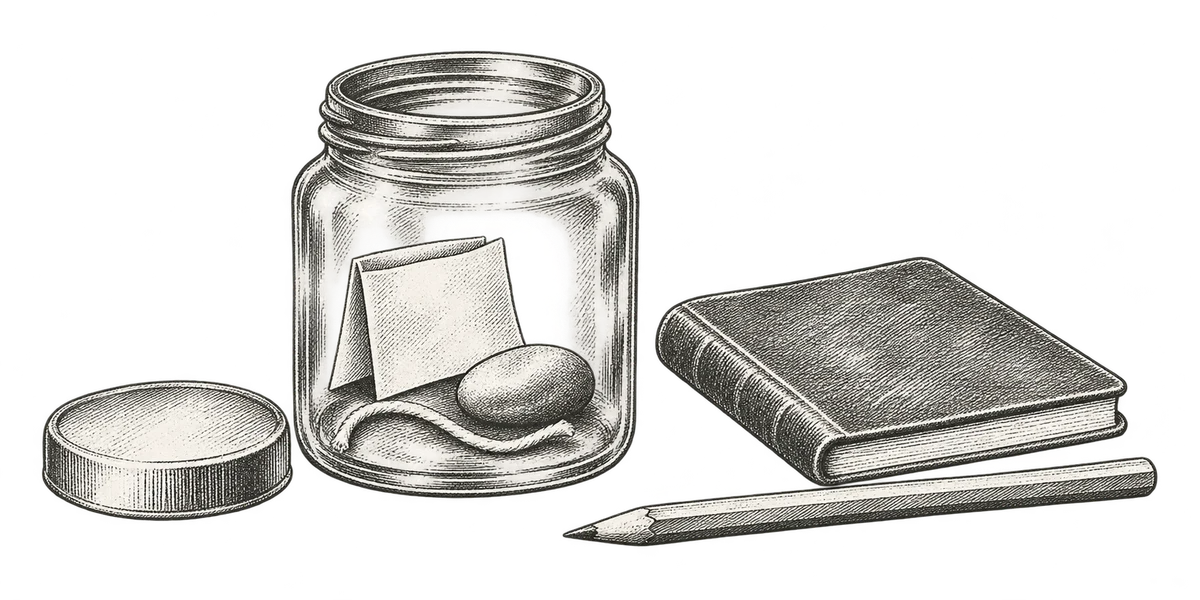
Here, a spell jar is a small container arranged around a stated intention. The objects give that intention a visible form: a folded sentence, a length of thread, an ordinary stone. Ask what each item contributes to the practice you are actually doing.
The name alone does not identify a tradition. A modern paper-and-stone jar, a named historical bottle charm and an unopened household jar used as a focus need their own explanations. Do not assume that their ingredients or histories are interchangeable. If studying a particular custom, look for its specific source before calling this exercise part of it.
Choose a few materials
Use a clean, dry, intact jar with a lid, a small paper slip, a pencil, one smooth stone you already own and a short piece of cotton thread or cord. Keep the notebook outside the jar. Three contents are enough; adding more does not make the exercise more complete.
Use meanings you can explain. Here, the paper names the decision, the cord represents a limit and the stone reminds you to return to something steady. These are chosen associations, not universal properties of the materials.
| Material | Role in this example | An ordinary substitute |
|---|---|---|
| Jar with removable lid | Holds the arrangement for review. | A small box or envelope. |
| Paper and pencil | Records the intention and review date. | A plain card. |
| Short cotton cord | Marks one limit you choose to keep. | A drawn line on the card. |
| One smooth stone | A familiar reminder to pause. | A small object with a meaning you can state. |
Give the jar one job
Choose something within your own conduct: making room to read, keeping a stopping time or pausing before answering a message. Write both the intention and the action. “I keep an evening boundary” can be paired with “At eight I close the work notebook.”
For a relationship intention, write what you will offer, ask or stop doing, while leaving the other person free to respond. A jar cannot verify consent, secure affection or guarantee a financial result.
A dry jar ritual
Set aside about ten minutes for this original exercise. Keep the jar on a stable shelf out of reach of children and pets. There is no flame, liquid, smoke or special date in this version.
- Write the intention on one side of the paper. On the other, write one action and a review date within the coming week. Keep a copy of the action in your notebook.
- Place the stone in the jar without dropping it against the glass. Put the loosely curved cord beside it, then add the folded paper. Leave the contents easy to remove.
- Look at the objects and name their jobs: “The words name my choice; the cord marks my limit; the stone reminds me to return.” These words are optional and original to this guide.
- Place the lid on normally. Do not glue or wax-seal it. Set the jar in the place you chose and close the notebook to end the session.
- Complete the ordinary action at the time you wrote. On the review date, take the jar apart over a clear surface and decide whether to keep, change or finish the intention.
An example to review
This is a fictional planning example, not an account of an editor performing the ritual. The intention is “I make room to read.” The action is “After dinner I put my phone aside and read for ten minutes.” The jar stays beside the reading chair, with its review date in the notebook.
At the review, record the evenings you actually read and any interruption. If the plan did not fit, shorten it or choose another time. An unused jar is a reminder to revise the plan; it is not evidence that you chose the wrong stone. One week cannot establish that the arrangement caused a change.
About seals and additions
A wax seal is not required. Keep the lid removable so the objects can return to ordinary use. Do not place a burning candle on the lid or heat a closed container.
The dry example needs no food, water, oils, loose powders or plant material. Another entry may use a sealed food jar without opening it; follow that entry rather than mixing its method into this one. Label a container if its contents could be confused with food, and keep non-food materials out of kitchen use.
Finish or change the intention
When the review is complete, open the ordinary dry jar over a tray and recover the objects. Keep the paper as a record or sort it according to local recycling rules. Untie the cord if needed, return the stone to its place and clean the vessel as its care instructions allow.
If you meet an old jar with uncertain, moldy or leaking contents, keep it closed and seek local disposal guidance. You can mark an ending in the notebook without opening it. The cleanup guide sorts materials individually and explains when not to handle a container.
Related workings from the archive
- The honey jar ward
Compare a separate archive working that keeps a household jar sealed. Read its own materials and source framing before adapting it.
Common questions
Do I have to seal a spell jar with candle wax?
No. This dry exercise uses an ordinary removable lid. A box or envelope can hold the same intention and objects.
Which herbs or crystals do I need?
None for this example. It uses paper, a short cord and a stone you already own. Add an object only when you can explain its job and handle it appropriately.
How long should I keep a spell jar?
Choose a review date before making it. This example uses the coming week, then asks you to finish, revise or continue the ordinary action. There is no universal expiry time.
Can I make a protection or prosperity jar?
You can choose a boundary or resource intention and an action within your control. Describe your associations clearly; the jar does not establish protection from danger or guarantee money.
Continue exploring
- The extraordinary life of ordinary things.
- Knot magic for beginners: cord spells, seven knots and source notes
- Protection symbols and charms: personal sigils, rowan and written signs
- Water scrying for beginners: setup, questions and a reading record
- Candle wax meanings: shapes, ceromancy and a reflection record
- New and full moon ritual calendar: November 2026–April 2027
- Yule traditions and winter-solstice spells
- Yule spells: ten book-informed winter workings
- Poppet magic for beginners: making and using a ritual figure
- Glamour magic for beginners: spells for confidence and presence
- How to make a sigil: a beginner’s guide to sigil magic
- Sigil meanings: reading and creating personal symbols
- How to charge a sigil: three simple rituals
- Ritual cleanup: how to dispose of spell remains
- Candle magic for beginners
- Moon rituals for intention and reflection
- Folk magic: household symbols and contemporary practice
- Witchcraft for beginners