Candle wax meanings.
Describe the shape before giving it a meaning. Wax can suggest a path, a fold or a familiar object, but the association belongs in a notebook beside the observation. This guide combines a brief book reference with an original reflection exercise.
What is ceromancy?
Ceromancy is a name used for divination involving wax. In Memoirs of Extraordinary Popular Delusions, Charles Mackay includes “Keromancy” in a list he attributes to Gaule through Hone, describing it as divination by melting wax. This establishes a named description in that book, not a universal method or a reliable prediction.
Mackay writes critically about divination. His list does not supply the shape dictionary used here or establish an ancient origin for every modern candle-reading practice. Our exercise uses already cooled wax, or a sketch, rather than asking you to melt and pour wax into water.
Start with what you can see
If you already have a used candle, wait until it and its vessel are fully cool. Leave the wax where it is; do not scrape a hot container, lift a burning candle or try to make a particular drip. You can use a sketch or photograph instead of lighting anything.
Record the outline, position and ordinary conditions you know. “A ridge on one side of the holder” is an observation. “Someone is resisting me” is an interpretation that the ridge cannot establish. Keep those sentences in separate parts of your record.
Shapes as notebook prompts
These associations are original suggestions for this exercise, not a traditional codebook. A shape can suggest more than one thing. It is equally useful to record that nothing recognizable appeared.
| What you describe | A possible association | A question to investigate |
|---|---|---|
| A line or branching trail | A route or a decision | Which two options can I compare using facts? |
| A rounded pool or enclosed outline | A limit or a contained task | What belongs within the time I have? |
| Separate pieces or islands | Several parts of a plan | Which part needs attention first? |
| A fold or raised edge | An unfinished detail | What small step could make this clearer? |
| No clear image | Uncertainty | What can I leave unresolved today? |
Leave room for ordinary causes
Candle construction and use affect how wax remains. The National Candle Association discusses uneven burning, drips, soot, wick condition and moving air in its care guidance. A ridge, a pool or darkened glass cannot tell you what another person feels or whether a working succeeded.
If a candle burns unusually, end the session and check its label or manufacturer’s advice. Do not extend a burn to force a flatter wax pool or a more pleasing symbol. The handling links below support candle care, separately from the book reference for the divination term.
A short wax-reading exercise
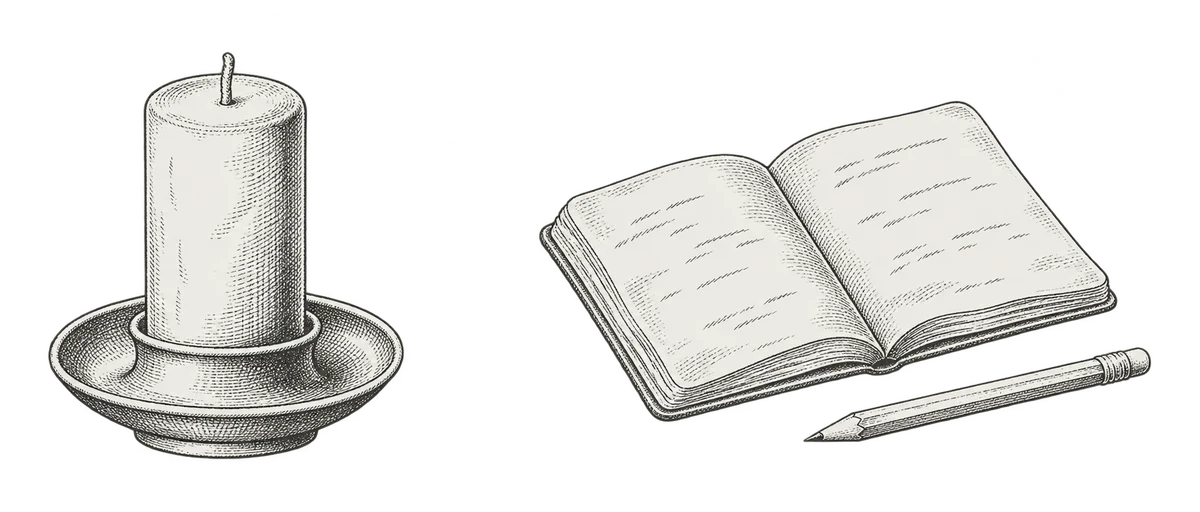
Bring a notebook and pencil. Use a fully cooled candle, its photograph or a simple drawing of a shape. This original contemporary exercise is for reflection; it does not test another person’s intentions or forecast an event.
- Write an open question about your choices, such as “What would make my next step clearer?”
- Describe three visible features before naming an image. For a sketch, state that you drew it rather than observed candle wax.
- Choose one possible association and write a different association beside it. Keep the first impression from becoming a verdict.
- Name the facts you need before making a decision. Write one ordinary action that can supply a fact or improve the situation.
- Close the notebook and sort leftover materials using the cleanup guide. At a later review, record the action separately from whether the shape still feels meaningful.
A worked observation record
This fictional example is not a report of a performed reading. The question is “How can I finish the application?” The observation is “Two narrow lines join a wider pool.” One association is two routes meeting; another is a branch entering a stream.
The next step is to compare the application requirements with the draft and list what is missing. The shape does not tell the writer whether they will be accepted. At the review, record what they checked, changed or submitted.
| Field | What to write |
|---|---|
| Observation | Two narrow lines meet a wider pool. |
| Association | A meeting point; alternatively, a stream. |
| Known facts | The application has three unanswered requirements. |
| Next action | Check the requirements and finish one answer. |
| Review | Record what was done, including anything unfinished. |
When the reading ends
An unsettling image is not evidence of a curse, an enemy or a relationship outcome. You can stop, record “unresolved” and return to the decision using ordinary information. Burning another candle is not required to settle the interpretation.
Keep wax out of drains and separate it from paper and glass recycling. Local waste rules and product instructions determine the disposal route. If a usable candle remains, follow its instructions for storage and supervised reuse.
Related workings from the archive
- The candle-flame omen
A separate exercise for observing flame movement. Follow its setup and distinguish interpretation from evidence.
Common questions
What do candle wax shapes mean?
A shape alone does not establish an event or hidden intention. Use a resemblance as a personal question, record it as an association and compare it with known facts.
Does a clean burn mean my spell worked?
No. How a candle burns is not a test of a ritual outcome. Review the actual action and circumstances recorded before beginning.
Do I need to pour wax into water?
No. This exercise uses fully cooled wax, a photograph or a clearly labelled drawing. It requires no heating or pouring.
Is black wax or soot a bad omen?
Colour and soot cannot establish an omen. Check the candle’s instructions and condition; keep the physical observation separate from any personal association.
Book sources and further reading
Memoirs of Extraordinary Popular Delusions, Volume III
Charles Mackay · 1841; consulted digital transcription
The divination list attributes its taxonomy to Gaule through Hone and names Keromancy as divination by melting wax. Supports that limited vocabulary note only. The shapes, prompts and cooled-wax exercise are original to Okkult.
Continue exploring
- On intention, attention, and the art of beginning.
- Knot magic for beginners: cord spells, seven knots and source notes
- Protection symbols and charms: personal sigils, rowan and written signs
- Water scrying for beginners: setup, questions and a reading record
- Spell jars for beginners: materials, intentions and a dry jar ritual
- New and full moon ritual calendar: November 2026–April 2027
- Yule traditions and winter-solstice spells
- Yule spells: ten book-informed winter workings
- Poppet magic for beginners: making and using a ritual figure
- Glamour magic for beginners: spells for confidence and presence
- How to make a sigil: a beginner’s guide to sigil magic
- Sigil meanings: reading and creating personal symbols
- How to charge a sigil: three simple rituals
- Ritual cleanup: how to dispose of spell remains
- Candle magic for beginners
- Moon rituals for intention and reflection
- Folk magic: household symbols and contemporary practice
- Witchcraft for beginners