Cord-cutting ritual without candles
A 10-minute cord-cutting ritual for letting go. Cut loose cotton thread with scissors, discard it, and keep a written boundary to review in a week.
Get the printable PDFMeaning and practice
A physical cord gives the phrase “cutting ties” a visible form. Modern cord-cutting practices vary, including visualization, scissors, and candle ceremonies. This original sequence uses scissors on a tabletop and focuses on your own attention and choices.
Choose one pattern you are ready to stop feeding, such as revisiting an old message thread. Cutting a cord does not erase memories, control someone else, or replace practical arrangements that still need attention.
What you’ll need
- A short length of cotton thread
- Two slips of paper
- A pencil
- Scissors
- An envelope
The ritual
- On one slip write “My attention.” On the other name the pattern you are releasing. Place them apart on a table.
- Lay the thread between the slips. Do not tie it around your body or attach it to candles.
- Write a boundary beneath “My attention,” such as “I will stop rereading the conversation tonight.” Choose something within your control.
- Say: “I release this pattern and return my attention to my own life.” Cut the thread at its center, keeping fingers clear of the blades.
- Place the slip naming the pattern and the cut thread in the envelope. Discard them with household waste when ready; do not leave thread outdoors.
- Keep your boundary slip in your journal. Take the action you wrote, then review how it felt after a week.
What to record for this working
These are notebook prompts, not reports of observed results.
- Before the cut
- Copy the pattern you named and the boundary you chose. Keep the wording so you can compare it with your later actions.
- The cut itself
- Record whether the thread separated on the first cut or needed another. Fraying or a second cut describes the material, not the strength of an attachment.
- A week later
- Did you keep the boundary, such as leaving an old message thread unread? Name the occasions you did and did not; recurring thoughts are not evidence that the cut failed.
Worked example: leave an old conversation alone
In this example, you keep rereading a conversation after dinner. On the pattern slip, write “Rereading old messages after dinner.” On the slip you keep, write “After dinner this week, I’ll archive the chat and leave it closed until morning.”
After cutting the thread, put the pattern slip and thread in the envelope and close the scissors. Archive the chat that evening. A week later, note which evenings you kept the boundary and decide whether muting the thread would help.
Compare the methods
The phrase covers several modern approaches. Their materials differ; no method can tell you what another person feels or change their choices. The tabletop scissors version above keeps the physical action separate from a flame.
| Approach | What you do | What to keep in mind |
|---|---|---|
| Visualization | Imagine a connection and choose words for letting go. | No objects are required. An image in your mind is not evidence about another person. |
| Scissors and loose thread | Cut a short length of thread lying between two notes on a tabletop. | Keep the thread away from your body and cut away from fingers. Pair the gesture with a boundary you control. |
| Candle-based versions | Some modern versions use candles as a focus for the ending. | This guide does not teach burning a cord. Thread, paper and decorations introduce fire hazards; an LED or unlit candle can serve as a symbol. Flame and wax patterns do not diagnose a relationship. |
Read the arrangement
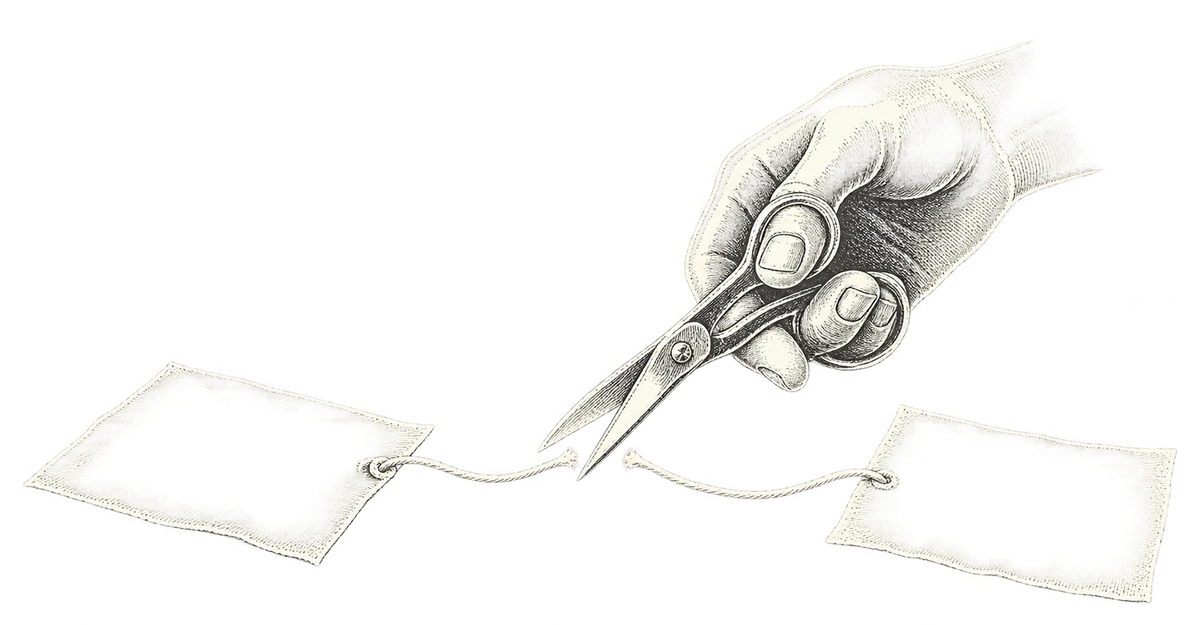
In the illustration above, the two paper slips name your attention and the pattern you are leaving. The loose thread lies between them rather than binding a person, body part or object. The cut is a visible end to one sequence; it is not a test of who holds power.
Leave the slips far enough apart that you can lift the cut thread without scattering it. Keep the scissors closed when you put them down. Move the thread into the envelope after the cut and record the practical boundary before clearing the table.
A seven-day record
The example below is invented to show how to keep notes. It is not a testimonial or a report that a ritual changed a relationship. Imagine the chosen boundary is “I will stop rereading an old conversation after dinner.”
| Check-in | An observation | A practical response |
|---|---|---|
| The same evening | I felt an urge to reopen the conversation. | Close the app and put the phone elsewhere for the evening. Write the urge down without calling it a sign. |
| The following day | The thought returned while I was doing something else. | Return to the task or seek a willing conversation with someone supportive. You do not need to repeat the cutting. |
| Midweek | I reopened the messages once. | Record the occasion and choose a more workable limit, such as turning off a notification. A lapse is information for the plan. |
| After seven days | I kept the limit on some evenings and want to revise it. | Name what helped, adjust one action and decide whether to keep or discard the note. |
What a result cannot tell you
A quick cut, frayed thread or a returning memory describes materials or experience. It does not prove that an attachment is broken, that someone is thinking about you, or that they will return. Repeating a ritual until a material behaves as desired can distract from the boundary you meant to keep.
This practice does not end practical responsibilities, shared arrangements or another person’s access by itself. Choose ordinary steps suitable to the situation. If a situation feels unsafe, prioritize practical support and safety rather than relying on a symbolic gesture.
Common questions
Do I need two candles?
No. This version uses scissors and thread. A flame or wax pattern is not evidence of another person’s feelings or whether you are allowed to move on.
What if I still think about the person afterward?
Memories and feelings can return. That does not mean the ritual failed or that someone has power over you. Return to the boundary you chose and seek support if you need it.
Explore the practice
Explore banishing spells for more context and related workings. For help choosing materials and recording your experience, read witchcraft for beginners.