A quieter Yule.
Begin with one thing you want to carry forward. An account of the Yule log offers a historical starting point; a dated card gives you a simple, flame-free way to mark your own season.
Yule and your season
Yule can refer to different historical customs and contemporary celebrations. The winter solstice is an astronomical turning point; a household celebration does not need to claim that every custom shares one origin or one fixed date. Name the practice and source you are actually using.
December is winter in the Northern Hemisphere and summer in the Southern Hemisphere. If you use a winter-solstice framework south of the equator, the local winter turning point is around June. A person celebrating in December can also describe it as a chosen festive observance rather than local midwinter. This guide does not prescribe one date for everyone.
Carry a fragment forward
In The Golden Bough, Chapter LXII.7, James George Frazer surveys accounts of midwinter fires. In the English account he cites through John Brand, part of a Yule log was kept to help light the next year’s log. The retained fragment connected one household occasion to another.
Frazer also records protective claims attached to log fragments. These describe beliefs in the accounts, not established protection from fire, lightning or illness. His proposed origins are interpretations, not a settled history of every Yule celebration. This guide borrows the idea of continuity, not a claim that a keepsake has protective power.
Gather a card and keepsake
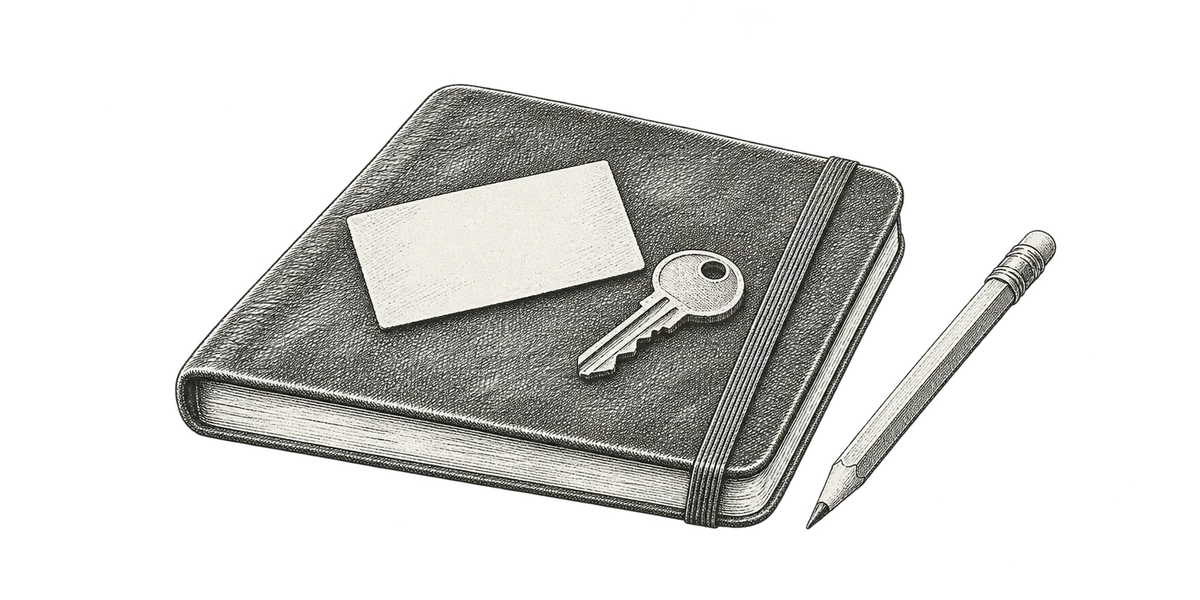
For the contemporary exercise below, use a notebook or card, a pencil and one small object already associated with the year: a key, a piece of cloth or a photograph you own. Allow about ten minutes. A drawing can stand in for an object you cannot keep.
Choose an ordinary indoor surface. No hearth, charred wood, collected greenery, candle or ash is needed. The card and keepsake are a newly composed Okkult practice; they are not presented as a reconstruction of Brand’s account.
A flame-free winter practice
This original sequence marks what you choose to carry forward. It can be done alone or with willing participants; each person chooses what to share.
- Write the date, your location’s season and one thing you want to remember from the year. Describe an event or effort rather than an omen.
- Place the keepsake beside the card. Write what connects it to that memory. If you have only a drawing, name the object it represents.
- Choose one quality to carry forward, such as patience or attention. Add a practical action: “I will protect one quiet evening each week.”
- Read the memory and action aloud or silently. Say, “I keep this memory, and I choose this next step.” Put the card in a notebook or another place you can find again.
- Complete the action, then return to the card at a review time you choose. At the next annual observance, decide what to keep, change or release.
An ordinary ending
Return the object to its usual place or store it with the note. There is no need to keep an unwanted object for a full year, and discarding a card does not invite bad luck. A written description can preserve the memory without preserving the material.
If you also follow a fire-based custom, use appropriate household fire precautions and product instructions rather than treating a historical account as a safety guide. This exercise remains complete without flame. For sorting other ritual materials, use the cleanup guide.
Related workings from the archive
- Yule returning light spell
Welcome a beginning with a paper sun and electric light; the candle motif is recorded by Frazer.
- Yule hearth peace spell
Fold a cloth around an intention for willing care, using Irving’s literary fireside as background.
- Yule winter abundance spell
Bring a coin and three resource tokens into the light, adapting the goods-and-candle motif described by Miles.
- Yule winter ward
Use a drawn holly leaf and removable knot for one boundary, adapting the holly belief discussed by Miles.
- Yule log keepsake charm
Carry a dated memory and promise between annual observances with an unburnt wooden keepsake.
- Yule orchard wassail
Address a fruit tree or drawing and pledge appropriate care, adapting the orchard custom recorded by Sandys.
- Yule first-foot welcome
Choose a willing arrival and a freely offered gift, adapting Sandys’s New Year account.
- Yule twelve-day omen book
Keep twelve weather observations and reflection questions, replacing the forecast claim recorded by Miles.
- Yule remembrance place
Set and clear a temporary place for a memory, adapting the prepared-table motif described by Miles.
- Yule greenery farewell
Take down one decoration and clear its place, adapting the varied closing customs recorded by Sandys.
Common questions
Is this an ancient ritual?
No. It is an original contemporary practice inspired by the recorded idea of carrying something from one year to the next. The historical log custom and the new exercise are described separately.
Do I need a burning log?
No. A card and an ordinary keepsake are enough for this exercise. Burning is not a condition for completing it.
What if December is summer?
Yes. Describe your own season and chosen observance honestly. Local winter-solstice timing and a December festive tradition need not be treated as the same thing.
Book sources and further reading
The Golden Bough, Chapter LXII.7: The Midwinter Fires
James George Frazer · 1922, abridged edition
Supports the discussion of the retained English Yule-log fragment through John Brand. Frazer’s comparative origins and protective claims are reported as historical interpretations, not established effects. The card, keepsake, words and action review are Okkult’s contemporary additions.
Continue exploring
- The kept Yule-log fragment
- Knot magic for beginners: cord spells, seven knots and source notes
- Protection symbols and charms: personal sigils, rowan and written signs
- Water scrying for beginners: setup, questions and a reading record
- Spell jars for beginners: materials, intentions and a dry jar ritual
- Candle wax meanings: shapes, ceromancy and a reflection record
- New and full moon ritual calendar: November 2026–April 2027
- Yule spells: ten book-informed winter workings
- Poppet magic for beginners: making and using a ritual figure
- Glamour magic for beginners: spells for confidence and presence
- How to make a sigil: a beginner’s guide to sigil magic
- Sigil meanings: reading and creating personal symbols
- How to charge a sigil: three simple rituals
- Ritual cleanup: how to dispose of spell remains
- Candle magic for beginners
- Moon rituals for intention and reflection
- Folk magic: household symbols and contemporary practice
- Witchcraft for beginners