What do sigils mean?
The meaning of a sigil depends on who made it, how it was used, and what was recorded about it. A personal mark can hold a precise intention without belonging to a universal dictionary of symbols.
Print the practice sheet
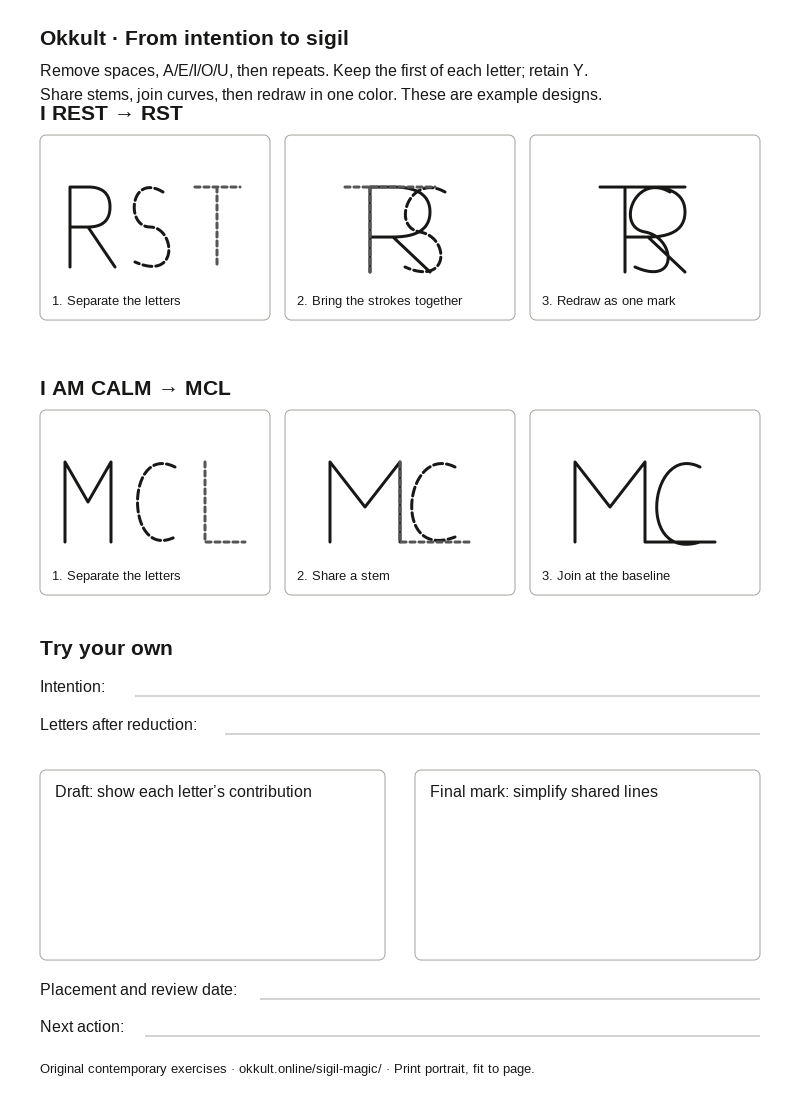
Start your personal symbol record with the printable sheet. It includes the I REST and I AM CALM examples, plus space for your own intention, reduced letters, and drawing. Keep any meanings you assign to added shapes in your notebook, then carry the sheet into the creation guide. Print in portrait orientation with “fit to page.”
What does a personal sigil mean?
A personal sigil takes its meaning from the intention you assign to it. If you design a mark for “I speak clearly,” that sentence is its key. Someone else looking at the same lines may see a branch, an arrow, or a letter; those associations do not replace your record.
Keep a private index with the drawing, intention, date, and use. You can choose to keep the intention separate from a card you carry. You do not need to publish its meaning for the symbol to be part of your practice.
Build a personal vocabulary of shapes
Use the following as prompts for your own designs. These associations are invented for this exercise and do not identify traditional symbols. Decide which meaning fits before adding a shape.
| Shape | An association you might choose | A design question |
|---|---|---|
| Circle | Containment or continuity | What belongs inside this intention? |
| Open arc | An opening or invitation | What am I making room for? |
| Crossbar | A boundary or stopping point | Where does this commitment end? |
| Branch | A choice or new direction | Which next step am I choosing? |
| Dot | A point of attention | What is the central purpose? |
Example: what the I REST sigil means
The illustrated I REST sigil combines the letters R, S, and T. In this example, the mark stands for a specific intention: close the work notebook at eight and review the decision the next morning. Write that meaning beside the finished mark so you can recover it later.
1. Separate the letters
2. Bring the strokes together
3. Redraw as one mark
How to approach an unfamiliar sigil
Start with where you found it. Look for a named maker, book, page number, inscription, or accompanying explanation. Preserve the orientation and surrounding text when taking research notes. A cropped drawing can lose the details needed to identify it.
Separate a source’s identification from your own impression. If you cannot trace a mark, label it unidentified. Avoid assigning a tradition, purpose, or harmful meaning from resemblance alone. Symbols from named traditions should be researched through sources specific to those traditions.
Compare documented examples
A personal key and a printed charm call for different kinds of record. The protection-symbols guide follows specific objects through their sources, materials and contemporary changes.
Make a symbol record
Use a notebook page for each new mark. This short record makes it possible to return to the design without guessing what you meant.
- Draw the sigil and write the intention in full.
- Record whether you invented it, adapted it, or copied it. For a copied mark, record the source and the passage explaining its use.
- Describe the meaning you assigned to each added shape. Leave uncertain identifications unresolved.
- Add its intended placement and a review date. After use, record what happened without treating coincidence as proof of cause.
Common questions
Can I work out a sigil’s meaning just by looking at it?
Usually you need its maker’s explanation or a source documenting its use. Visual resemblance can suggest a research question, but it does not settle an identification.
Can two sigils have the same meaning?
Yes. Two makers can choose the same intention and arrive at different drawings. One maker can also redesign a symbol while keeping its purpose.
Can I change the meaning of my own sigil?
Yes. Date the change and write the new meaning clearly. If the old association remains strong, making a fresh design may be easier.
Continue exploring
- On intention, attention, and the art of beginning.
- The extraordinary life of ordinary things.
- Knot magic for beginners: cord spells, seven knots and source notes
- Protection symbols and charms: personal sigils, rowan and written signs
- Water scrying for beginners: setup, questions and a reading record
- Spell jars for beginners: materials, intentions and a dry jar ritual
- Candle wax meanings: shapes, ceromancy and a reflection record
- New and full moon ritual calendar: November 2026–April 2027
- Yule traditions and winter-solstice spells
- Yule spells: ten book-informed winter workings
- Poppet magic for beginners: making and using a ritual figure
- Glamour magic for beginners: spells for confidence and presence
- How to make a sigil: a beginner’s guide to sigil magic
- How to charge a sigil: three simple rituals
- Ritual cleanup: how to dispose of spell remains
- Candle magic for beginners
- Moon rituals for intention and reflection
- Folk magic: household symbols and contemporary practice
- Witchcraft for beginners