Protection symbols.
A sign has more to tell you when you know who used it, what it was made from and where its meaning was recorded. Begin with three different kinds of object: a personal mark, a plant charm and a printed talisman.
Read a symbol in context
A mark on a pendant, a branch above a doorway and a drawing in a notebook can all be described as protective. That shared description does not make their histories or instructions the same. Keep the object, its setting and the source together.
When a picture circulates without a caption, start with what remains visible: the outline, writing, orientation and material. Record what you do not know. Resemblance can help you search for a source, but it cannot identify a tradition or decide that an unfamiliar sign is dangerous.
| Question | What to record | What it can clarify |
|---|---|---|
| Who made or described it? | A maker, book, edition or identifiable collection. | Whether the explanation belongs to this particular object. |
| What is the object? | Material, writing, orientation and placement. | Which details a cropped picture may have removed. |
| What does the source actually say? | A short paraphrase and page or section. | The difference between a recorded claim and your own association. |
A personal protection sigil
In Okkult’s contemporary exercises, you can give a drawn mark a boundary intention. Write a sentence within your own conduct, such as “I keep my evening private.” Give it a practical action, such as deciding when to stop answering work messages. The drawing represents that decision; it does not establish protection from danger.
The creation guide shows how to reduce a sentence and combine its strokes. Keep your full sentence beside the design in a private record. A crossbar can mean a limit in your design without becoming the meaning of every crossbar found elsewhere. No historical lineage is claimed for this personal method.
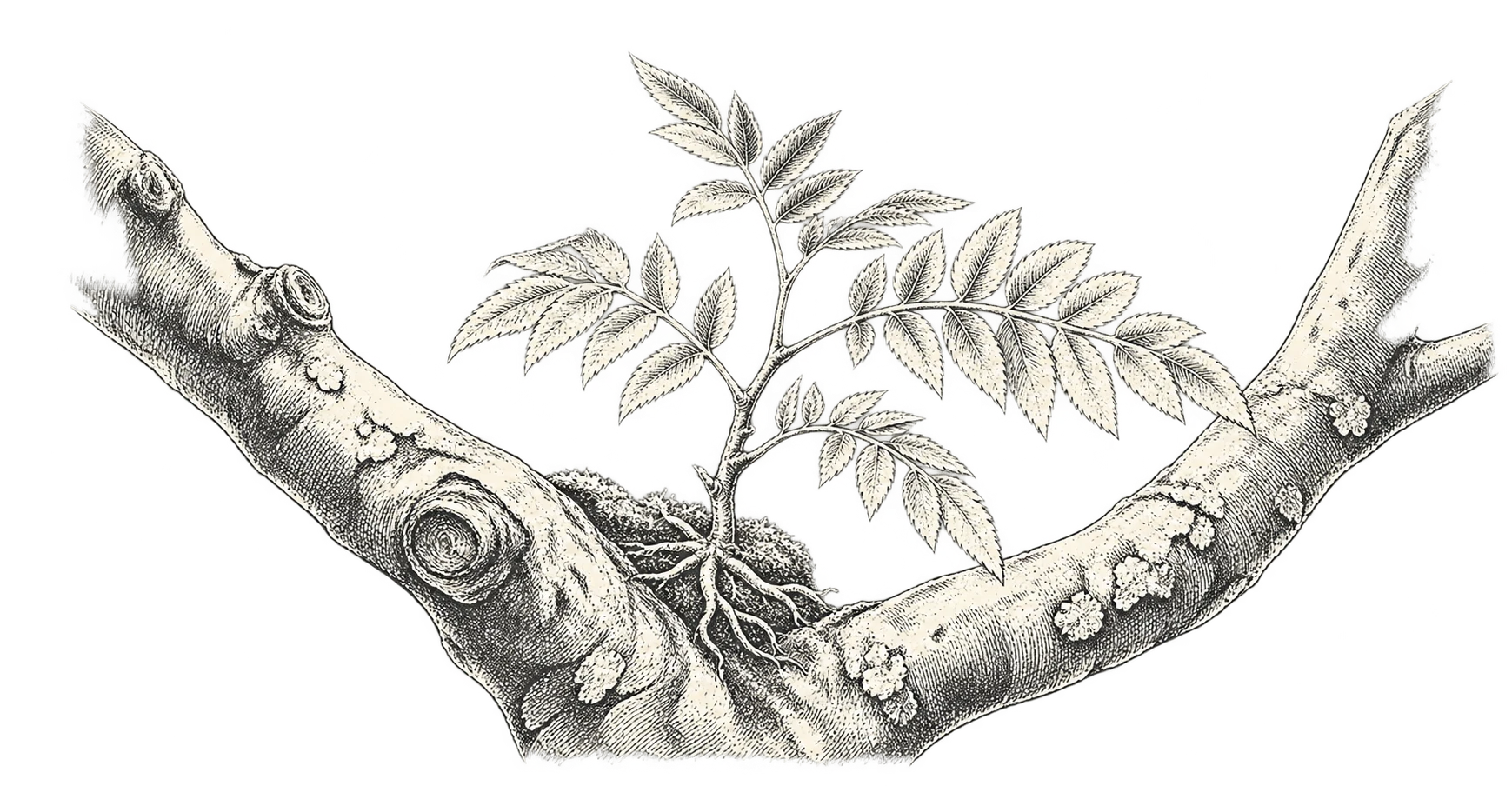
The place a rowan grows
In chapter LXVIII of The Golden Bough, Frazer reports a Jutland belief about rowan growing on another tree and its placement above doors. He also discusses flying rowan in Sweden and Norway. The growing place belongs to these accounts; the passage does not make every rowan-shaped drawing an equivalent charm.
Okkult’s paper ward deliberately changes the material. It uses a drawing, household words and an accessible place beside the inner doorframe. Its entry names those additions rather than claiming that the paper fulfils the book’s conditions for the plant. You can study the motif without gathering plant material.
A sign and its instructions
Noe’s 1885 handbook prints a protective talisman on page 84. Its account specifies tin, lunar timing and concealment from other people. Those details help identify the printed object; the accompanying promises remain claims of the handbook, not established effects.
The archive’s talisman article reads that page beside a different design associated with Venus. Consult the original page for its marks. Copying an outline onto paper creates a study drawing with changed material and use; it does not reproduce all the instructions attached to the printed object.
When the layout matters
The archive’s Abracadabra study provides another kind of comparison: a word arranged as a triangle. It concerns historical claims about illness, rather than the personal-boundary exercise above. The two arrangements below retain their different sources and directions.
Read the caption and source labels with the rows. A freshly typeset diagram is a study aid; it is not a facsimile or a treatment instruction. For the book context and the limits of the comparison, continue to the journal article.
Noe: diminishing
11 letters to 1, reading down
A. H. Noe, The Witches’ Dream Book; and Fortune Teller (1885), p. 84. Transcribed from the printed rows.
Forsyth: growing
1 letter to 11, reading down
J. S. Forsyth, Demonologia (1827), p. 57. Reconstructed from the prose description.
Make one useful record
Choose either a personal design or a sourced object. A single complete page is more useful than a collection of unexplained pictures. Use the fields below and leave an uncertain attribution unresolved.
- Draw or describe the object without changing its orientation. Record whether the image is a copy, a reconstruction or your own design.
- Write the maker or book reference. For a personal sigil, write “Original personal design” and its full intention.
- Name the material and placement in the source, then state the changes in your own version separately.
- Add the practical action if you are using a contemporary boundary exercise. A study page does not require you to perform the instructions you read.
- Date the record. On returning, revise an uncertain identification only when you have a better source. Keep the earlier note so the change remains visible.
Choose the next practice
For a home boundary, begin with the protection category’s doorway practices. For a personal mark, use the sigil guide. For historical reading, follow the particular book page rather than adding an unlabelled symbol to a new mixture.
You can retire a paper reminder when its purpose changes. Date the ending, keep a useful source note and sort the paper normally. The contemporary exercises here do not require another symbol to cancel an earlier one.
Related workings from the archive
- The flying-rowan ward
A paper adaptation with explicit notes about the historical motif and contemporary changes.
- A charm for the threshold
An original household exercise using water, a cloth and a written intention.
Common questions
Is there one dictionary of protection symbols?
A useful explanation needs the particular maker, source and use. Similar outlines can carry different meanings; a personal sigil needs its maker’s key.
Can I draw my own protection symbol?
Yes, as an original personal design. State its intention and an action within your control, and distinguish it from a copied historical object.
Can I identify a symbol from its shape alone?
The shape may suggest a research route, but orientation, text, material and provenance matter. If the source cannot be traced, keep the identification uncertain.
Book sources and further reading
The Golden Bough, chapter LXVIII
James George Frazer · 1922 abridged edition
The flying-rowan passage supports the specific growing-place and doorway account. It does not document Okkult’s paper substitute or establish protective effects.
The Witches’ Dream Book, pp. 84–85
A. H. Noe · 1885
Supports the printed protective talisman’s material, timing and concealment, and the diminishing Abracadabra rows. Historical promises are retained as claims of the book.
Demonologia, p. 57
J. S. Forsyth · 1827
The growing Abracadabra diagram is reconstructed from this prose description, as labelled in the existing comparison component.
Continue exploring
- The Abracadabra triangle
- The Venus and protective talismans
- Knot magic for beginners: cord spells, seven knots and source notes
- Water scrying for beginners: setup, questions and a reading record
- Spell jars for beginners: materials, intentions and a dry jar ritual
- Candle wax meanings: shapes, ceromancy and a reflection record
- New and full moon ritual calendar: November 2026–April 2027
- Yule traditions and winter-solstice spells
- Yule spells: ten book-informed winter workings
- Poppet magic for beginners: making and using a ritual figure
- Glamour magic for beginners: spells for confidence and presence
- How to make a sigil: a beginner’s guide to sigil magic
- Sigil meanings: reading and creating personal symbols
- How to charge a sigil: three simple rituals
- Ritual cleanup: how to dispose of spell remains
- Candle magic for beginners
- Moon rituals for intention and reflection
- Folk magic: household symbols and contemporary practice
- Witchcraft for beginners