The Venus and protective talismans
Read two illustrated talismans in Noe’s handbook through their metal, timing, placement, and stated purpose.
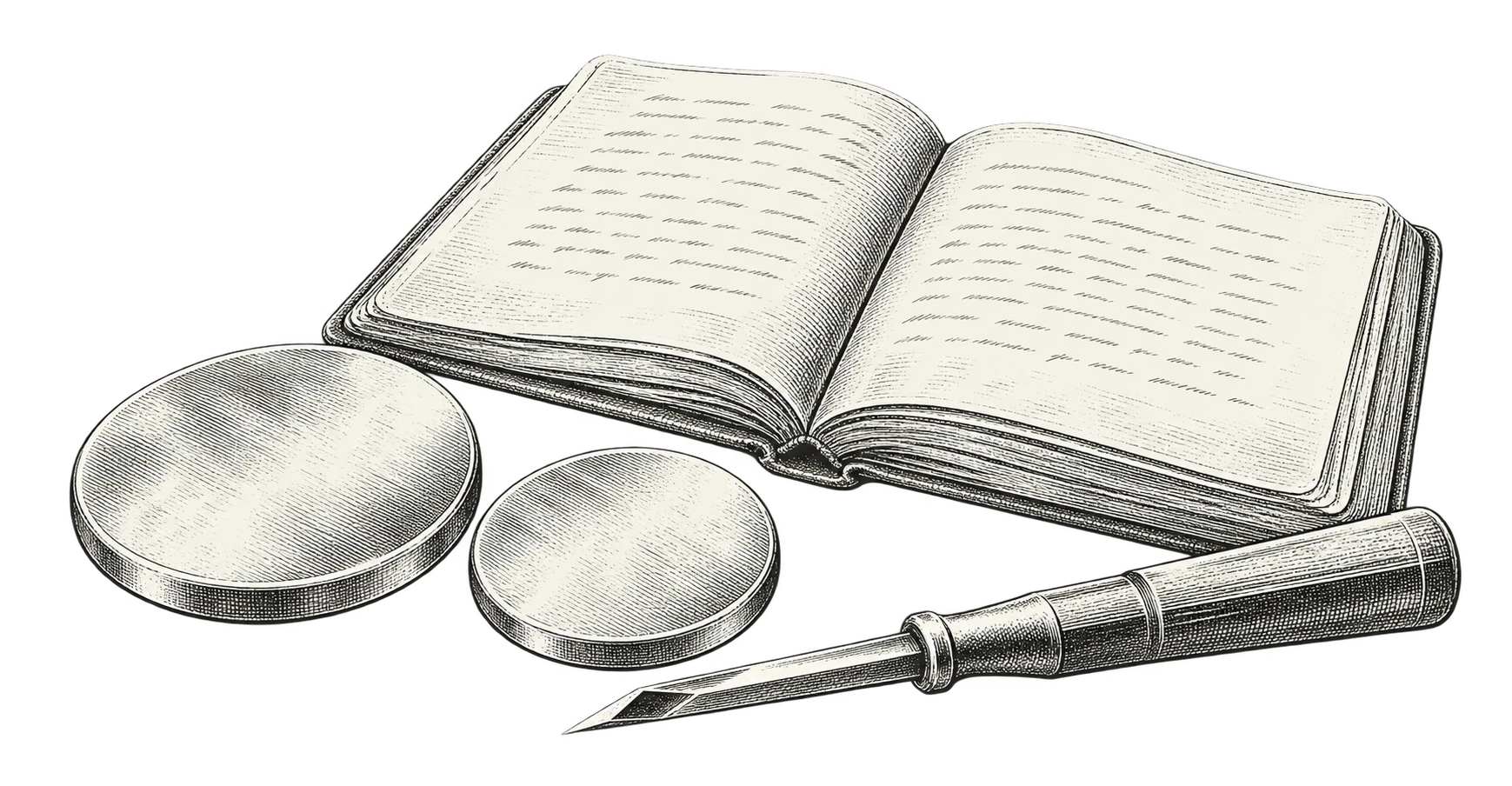
The talisman pages in Noe’s handbook ask you to notice more than a sign. Material, timing, and the place where the object is worn all belong to the description. Copying the outline alone would leave much of the printed object behind.
Two examples are especially useful to compare: a love talisman associated with Venus and a concealed talisman against enemies. The first is specified in silver when Venus is an evening star; the second in tin during the increasing moon. They share a page, but their conditions are not interchangeable.
Diagram and instruction
Consult the original illustrations through the source link rather than replacing their marks with decorative symbols. A character that is difficult to read should remain uncertain until it can be checked. It does not become a rune merely because it looks old.
The wearer’s relationship with the object also differs between the accounts. The love talisman is placed over the heart; concealment is part of the protective one. Those instructions tell us something about how the book imagines the objects being used, even without accepting its promises.
A paper copy is a new object
A study drawing can preserve the design for a notebook. It is not a silver or tin talisman made under the stated conditions. If you make a paper charm inspired by either account, identify the changed material, marks, words, and timing instead of presenting the result as an exact reproduction.
This post keeps the two talismans as historical objects. It does not provide metal-casting instructions or claim a verified lineage for their diagrams. Their interest lies partly in the particular instructions the book attaches to them, and partly in the questions those instructions leave open.
Source and reading notes
The original illustrated page is the reference for the designs. No replacement glyphs or unsourced engraving instructions have been supplied.
A. H. Noe, The Witches’ Dream Book; and Fortune Teller (1885). Love and protective talismans, p. 84.