The sieve oracle
Examine the movement and accusation in a printed sieve-divination account without treating it as evidence of guilt.
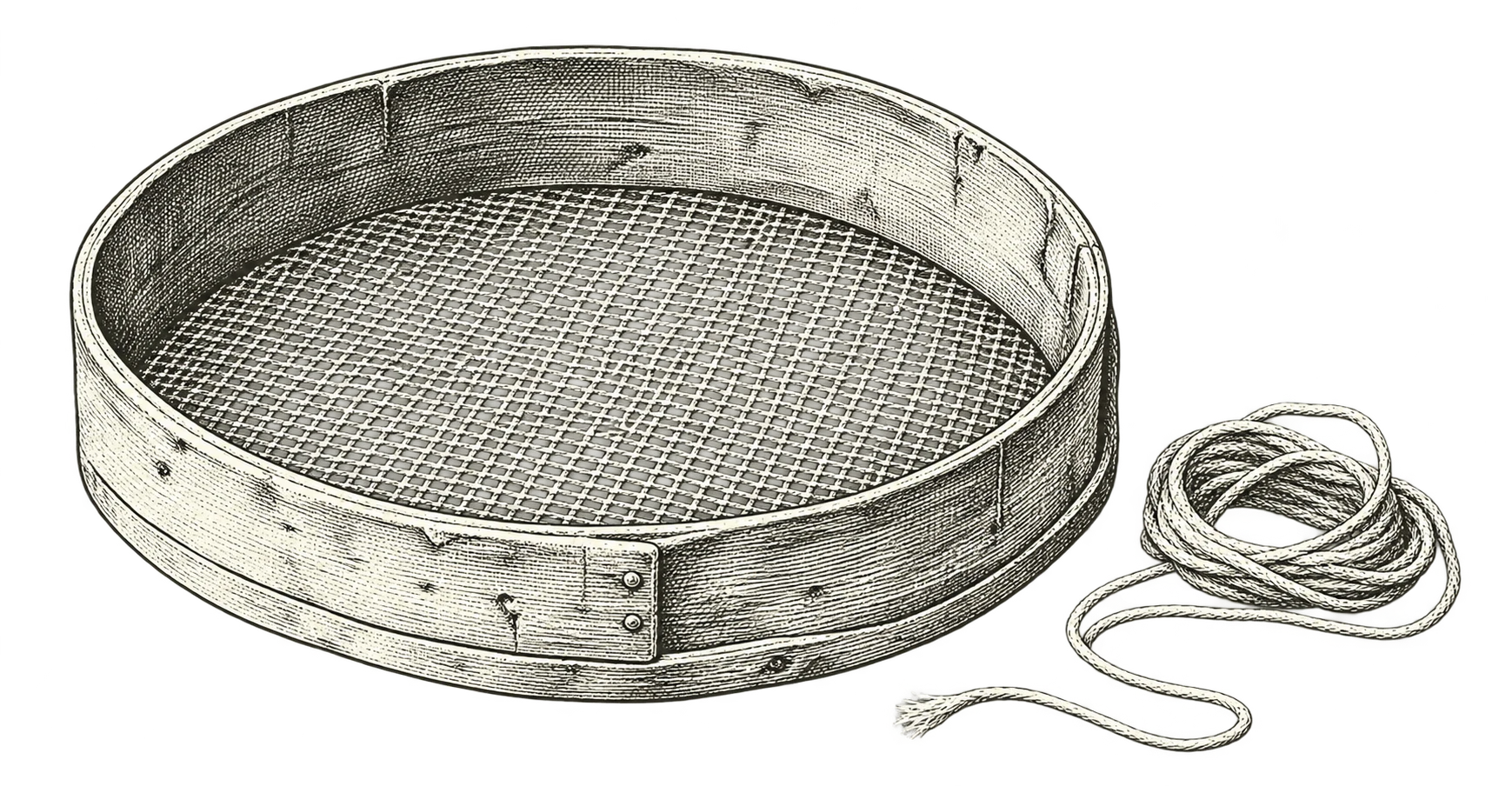
An ordinary sieve becomes a much less ordinary object when somebody’s name is spoken over it. Forsyth describes methods in which the sieve moves while suspected people are named, and the movement is interpreted as an answer.
The practical difficulty is also the ethical one: a hand-held or suspended object can move, but that movement does not establish that the person named committed an offence.
A domestic object in a formal role
The account includes more than one way of supporting the sieve, and compares its use with older references. Keep those variants separate rather than illustrating one arrangement as if it exhausted the description.
What makes the story consequential is not simply its unusual apparatus. It is the step from a motion to an accusation. The person being named does not become accountable for a tremor in someone else’s hand.
What the archive preserves
This post preserves the name coscinomancy and the source’s description of the interpretive move. It does not offer a list of suspects, words to determine a thief, or instructions for balancing scissors beneath a moving sieve.
If you are comparing it with pendulum work, notice the shared problem of separating a physical observation from a claim about somebody else. The archive’s pendulum question keeps a clear written record and asks for facts to be checked outside the reading.
Historical interest does not require repeating a procedure that turns an ambiguous motion into a verdict on another person.
Source and reading notes
The sieve methods are discussed as reported practices. Neither the motion nor the attribution of antiquity is treated as proof that the accusation was justified.
J. S. Forsyth, Demonologia (1827). Coscinomancy, p. 146.