The letter lots
Explore Forsyth’s account of letters and words drawn as lots, keeping it separate from his book-opening examples.
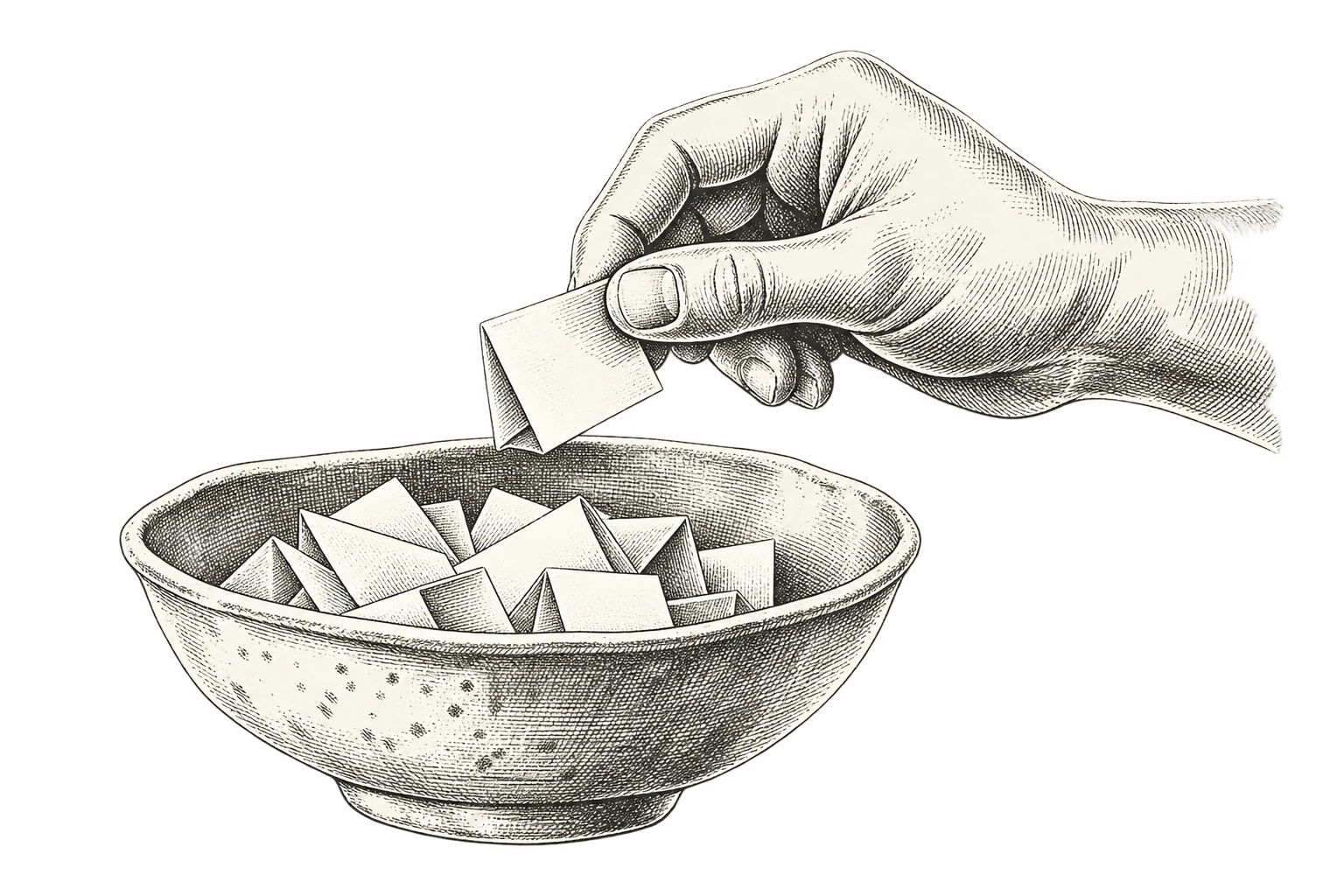
A letter drawn by chance can begin a word, but somebody still has to decide what the word will be. That act of interpretation is easy to miss when an oracle is described in a few confident lines.
In his discussion of sortes, Forsyth describes letters or words placed together, mixed, and interpreted. He also discusses passages taken from books. These are distinct material procedures even when a compiler puts them under one heading about lots.
Read the arrangement before the answer
Loose letters allow rearrangement. Whole words carry a different constraint. A passage encountered in a book already has a surrounding sentence and a speaker. Treating the three as interchangeable hides where the interpreter has room to choose.
Forsyth’s historical labels and succession of examples also require care. His compilation is evidence of what he printed, not by itself a complete chronology of those practices. We retain his attribution instead of turning it into an unqualified origin story.
A modern set would need its own rules
If you make letter lots for yourself, decide the alphabet, repetitions, number drawn, and treatment of a result that makes no word before you begin. Those would be rules of your version. The sparse account here does not supply them.
For a finished practical exercise with its changes already declared, the Lenten card draw offers letters, numbers, and blanks. For passages with an existing literary context, use the opened-book oracle. Neither is presented as this letter-lot account reconstructed.
Source and reading notes
This is a historical comparison, not a procedure attributed to an ancient oracle. Gaps in the printed account remain visible.
J. S. Forsyth, Demonologia (1827). Sortes and sortilegium, p. 273 onward.